
We will begin our adventures with a brief foray into the Plus of the Appendix N wilderness.
The Gygax-Kaye monogram graced the covers of TSR’s efforts from its first publication in 1973 of Cavaliers and Roundheads until being replaced with Greg Bell’s Lizardman image in 1975. It was the company’s first logo, representing the partnership of Gary Gygax and Don Kaye, and it would herald them through TSR’s first formative years.
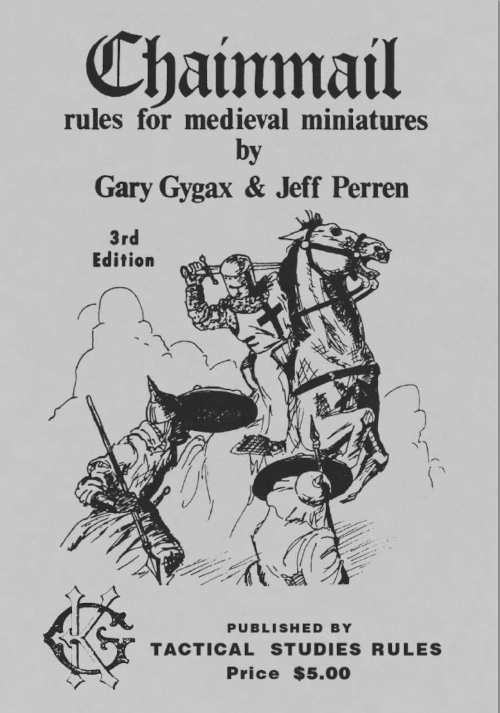
Chainmail, 3rd edition
The source material of much of the early artwork at TSR[i] and its precursors has been discussed over the years.[ii] From Jack Coggin’s knight[iii] appearing in the Castle & Crusade Society’s Domesday Book #5 and on the cover of Chainmail to Greg Bell’s Dungeons & Dragons illustrations inspired by panels of Dr. Strange.[iv] However, one question remained outstanding.
As Art & Arcana relates, Gygax was not a draftsman, and he eagerly canvased his social circle for contributions in those early years without an art budget.[v] Yet the hand that drew the “bold” and “distinctive” monogram does not resemble that of any of the early contributors. What, then, was the origin of the Gygax-Kaye monogram logo?
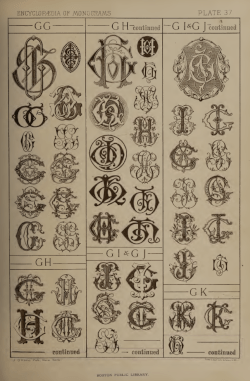

Preliminary research in the Lake Geneva Public Library’s catalogue returned no promising leads. Instead, an effort manually searching texts at the Internet Archive showed some result. James O’Kane’s An Encyclopædia of Monograms, published in 1884, exhibited multiple close, but not exact G.K. monograms (Plates 37, 38, and 55).[vi] Perhaps as a model for inspiration, it was close; but these entries in the Encyclopædia also suggested a period and style to refine the research. And indeed, further searching returned an anonymous record, simply titled, A monogram and alphabet album. Plate 34 contained the exact G.K. monogram logo.[vii]
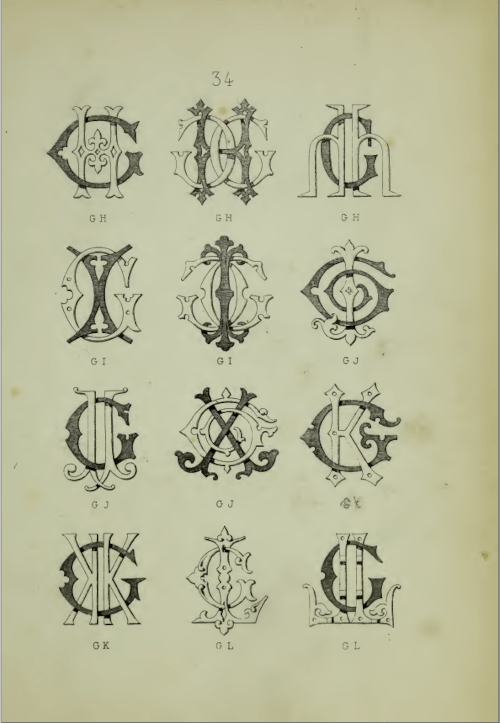
The Internet Archive record was sparse, noting no title page or author, but indicated an 1878 publication date and English as the text’s language. More interestingly was the contributor, the University of Illinois Urbana-Champaign, and the book’s call number, 745.6 M755. Searching the University’s catalogue returned an entry for the book, its location in the Oak Street Library vaults,[viii] and link to a scanned copy hosted at the Hathi Trust digital library.[ix] These additional library records all indicated the book’s language as English, although the few lines of text in the book were clearly written in French.
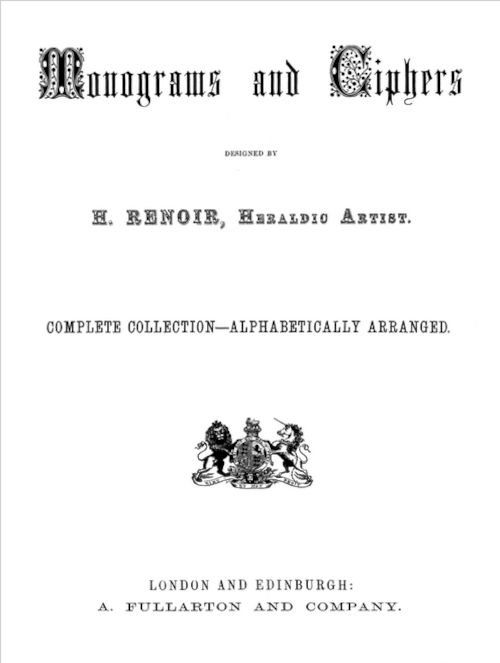
Pursuing the French connection quickly returned a modern, 1970 reprint of the plates in Cirker’s Monograms and Alphabetic Devices, [x] with a copy being held by the University of Illinois;[xi] and it also revealed the name of the monogram’s original French draftsman: H. Renoir. WorldCat[xii] provided further identity confirmation and various titles, including the original French title Chiffres et monogrammes, and print dates in France (Sarazin, Paris) in Germany, and the English title Monograms and Ciphers, published at Edinburgh.[xiii] The task remaining was to recover an intact copy at auction and examine the English edition’s cover and title page.[xiv] The physical book’s cover and binding were in a state of disintegration, and if the edition is a proximate example of the one held at the University of Illinois, the missing cover and title page are readily explained. Several questions, however, remain.
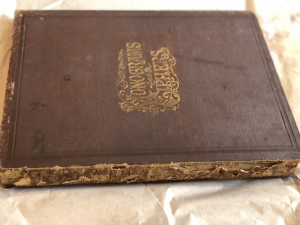

Monograms and Ciphers
While it is tempting to name the mysteriously labeled A monogram and alphabet album held by the University as the unique source from which someone copied the Gygax-Kaye monogram, Dover had also just recently published Cirker’s Monograms and alphabetic devices in 1970, and that may very well have been the reference text. Nevertheless, the missing title page and the penciled-in “GK” in the “album,” the only such marked monogram in the University’s copy, remain suggestive, together with the April, May, and November 1971 dates stamped on the album’s flyleaf.
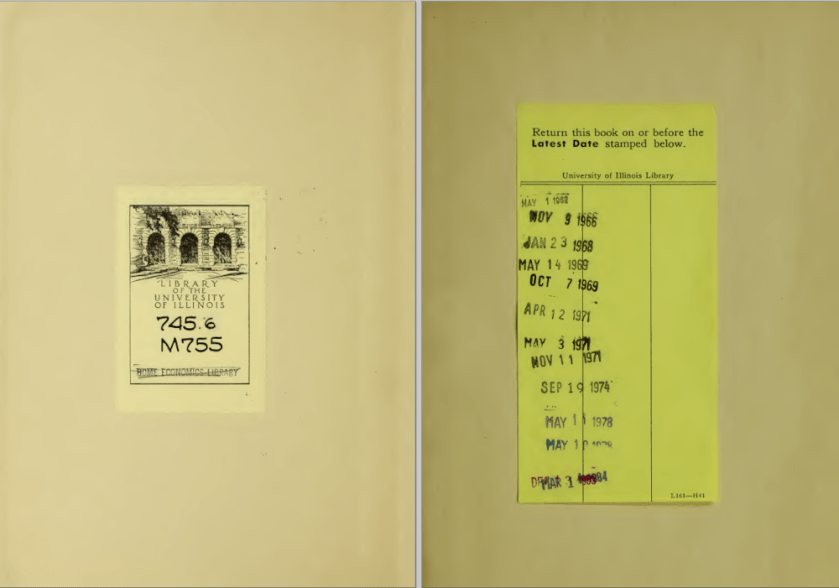
A monogram and alphabet album, flyleaf
Still, the evidence so far examined is perhaps at best circumstantial, even considering the tantalizing note in Peterson’s Playing at the World that “By 1970,” Gary’s confidant Len Lakofka was “pursuing a master’s degree at the University of Illinois at Urbana-Champaign.”[xv] It’s tempting to imagine Lakofka and Gygax huddled together over an old, crumbling book’s pages. Yet, without further investigation in physical catalogues, if they are even extent, it is uncertain where either volume was located in the early 1970s.
Which text was Gygax’s source, and who, if anyone, supplied it to him and Don Kaye? The answer to that may perhaps be forever shrouded in the primeval mists of Lake Geneva. But as far as this research can now conclude, the ultimate source of the Gygax-Kaye monogram was one H. Renoir, author, illustrator, and heraldic engraver.
[i] Acaeum. Original D&D Set.
[ii] OSR Grimoire. The Castle and Crusade Society. 2019.
[iii] Coggins, Jack. The Fighting Man: An illustrated history. Doubleday, 1966.
[iv] Maliszewski, James. Grognardia. The Mighty Marvel Method. 2009.
[v] Witwer, Michael, et. al. Dungeons & Dragons Art & Arcana: A Visual History. Ten Speed Press, 2018.
[vi] O’Kane, James. An Encyclopædia of Monograms. 1884.
[vii] University of Illinois Urbana-Champaign. A monogram and alphabet album. 1878.
[viii] University of Illinois Urbana-Champaign. Library Catalogue, 745.6 M755.
[ix] Hathi Trust Digital Library. A Monogram and Alphabet Album. New York, 1878.
[x] University of Illinois Urbana-Champaign. Library Catalogue, 745.61 C496M.
[xi] Cirker, Hayward and Blanche. Monograms and Alphabetic Devices. Dover Publications, 1970.
[xiii] WorldCat. Monograms and ciphers.
[xiv] Ebay. Antique monograms and ciphers designed by H. Renoir.
[xv] Peterson, Jon. Playing at the World. Unreason Press, 2012.
 Appendix N Plus