
And we return from the stacks with a few painted leaves in hand.
“The Sign of Chaos flashed on their sails, eight amber arrows radiating from a central hub—signifying the boast of Chaos, that it contained all possibilities whereas Law was supposed, in time, to destroy possibility and result in eternal stagnation. The sign of Law was a single arrow pointing upwards, symbolising direction and control.” – Stormbringer, Michael Moorcock[i]
The signs of Chaos and Law are perhaps the most recognized among devices borne by protagonists within the Appendix N corpus.
“He looked down at the great, round shield with its shifting amber arrows and its mysterious silver-green colour. He picked it up easily enough and placed it on his arm. It virtually covered his body from chin to ankles.” Stormbringer, Michael Moorcock
The earliest extant depiction in print of the sign of Chaos appears in the Stormbringer graphic novel of 1976.[ii] TSR would soon illustrate the signs of Chaos and Law in the first printing of Deities and Demigods (1980).

from Deities and Demigods, 1st printing[iii]
Moorcock describes the Sign of Chaos as ‘eight arrows radiating from a central hub,’ resembling more a heraldic escarbuncle charge than those illustrations in which the lines of the arrows simply intersect.
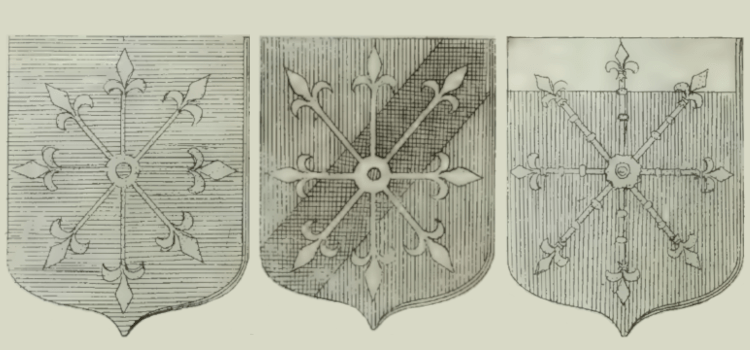
Examples of Escarbuncles, from Tesserae gentilitiae[iv]
There is also passing resemblance to Legio Britannia Secunda’s shield device as given in the Notitia Dignitatum.
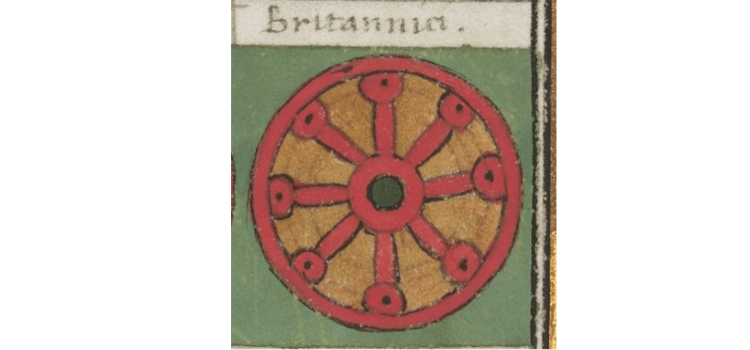
from Notitia dignitatum[v]
Arrows and spears are common enough charges in Western heraldic art, with the Pheon or Broad arrow variant most closely approximating the usual directional arrow representations of the Sign of Law.
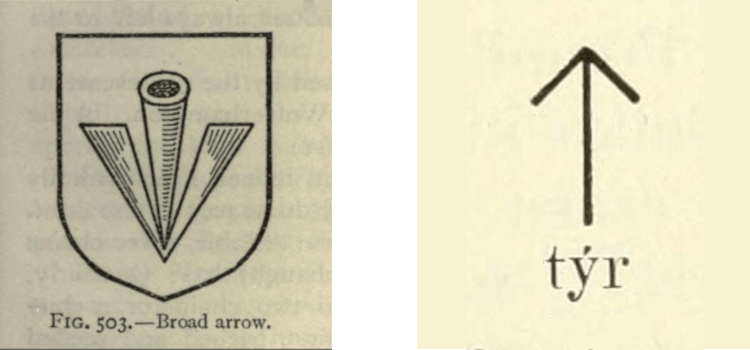
Broad arrow from A Complete Guide to Heraldry, Fox-Davies,[vi] and Týr rune from Rycerstwo polskie wieków rednich, Piekosiski[vii]
Polish heraldic art makes frequent use of the basic form, as the strzała and rogacina charges, themselves stylized bar characters of arrow and arrowhead. Note also a resemblance between the Sign of Law and the Futhark t-rune, which letter derives from an ideograph for a spear.

Arrowhead variants from Heraldyka polska wieków średnich, Piekosiński[viii]

and Tablice odmian herbowych Chrząńskiego, Ostrowski[ix]
“Resting on the deck against the golden rail of the bridge was the great round warboard, his shield, bearing the sign of the swooping dragon.” – Elric of Melniboné, Michael Moorcock.
Elric, too, bore his own coat of arms, described as a swooping dragon.
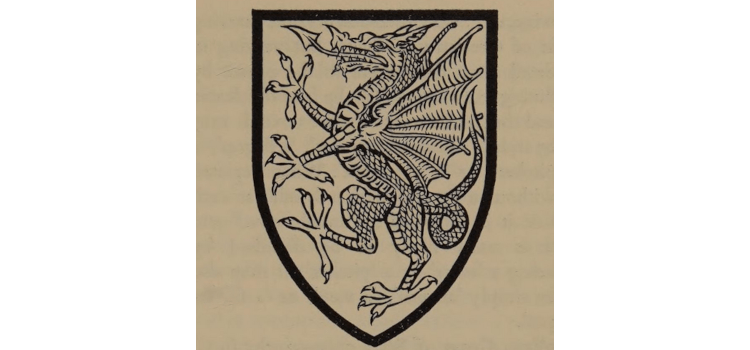
A dragon segreant wings elevated, from An Encyclopaedic Dictionary of Heraldry, Franklyn[x]
“Turning, Hawkmoon recognized the insignia on the man’s coat as his own, the arms of Koln.”
And although he does not specifically describe it, Moorcock names Dorian Hawkwind’s coat of arms as those of Koln.
“Count Brass ordered his herald forward, and the men approached, bearing the simple flag of his master – a red gauntlet on a white field.” – The Jewel in the Skull, Michael Moorcock
The red slate roofs and scarlet flamingoes of the Kamarg, Count Brass’s bronze tan “glowing red,” this larger-than-life hero’s strength and protection, all find their thematic echo in his armorial bearings.

Gauntlet (Fig. 540), from Fox-Davies’ Complete Guide
“Count Brass looked hard at the carriage. […] On the doors was an elaborate coat of arms displaying many quarterings in which were strange-looking animals, weapons, and symbols of an obscure but disturbing nature. Count Brass recognized the design of the carriage and the coat of arms. The first was the workmanship of the mad smiths of Granbretan; the second was the coat of arms of one of that nation’s most powerful and infamous nobles.” – The Jewel in the Skull, Michael Moorcock
In stark contrast with Count Brass’s simple device, the elaborate, many-quartered coat of arms of Baron Meliadus readily illustrates the anxious, fanatic decadence of Granbretan.
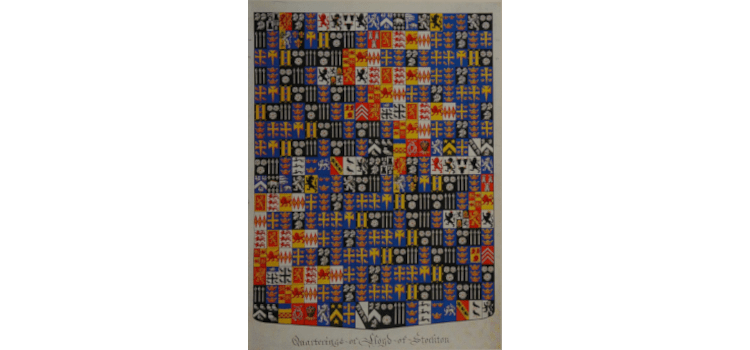
The Quarterings of Lloyd of Stockton, an extreme example, from The Oxford Guide to Heraldry, Woodcock[xi]
“… memories going back to my childhood in the great palace of Amber, with the green banner of my father Oberon flaring above it, white unicorn rampant, facing to the dexter.” – Nine Princes in Amber, Roger Zelazny
Zelazny’s chronicles of Amber abound with color and symbolism. Corwin’s personal colors thread black and silver through his memories until he reclaims them walking the Pattern, finally recalling the Sign of the Unicorn, the arms of his father Oberon.

A unicorn rampant, from The Art of Heraldry, Fox-Davies[xii]
“When I was dry again, I was given fresh garments, of black and of silver. I donned them, and a black cloak was hung about my shoulders, its clasp a silver rose. ‘You are ready,’ said the sergeant of the guard. ‘Come this way.’” – Nine Princes in Amber, Roger Zelazny
And so, we will continue these pursuits.
[i] Moorcock, Michael. Stormbringer. DAW, 1977.
[ii] Gideon. “The Sign of Chaos.” Awesome Lies. 2020, January 1.
[iii] Ward, James, and Robert Kuntz. Deities & Demigods. TSR Games, 1980.
[iv] Pietrasanta, Silvestro. Tesserae gentilitiae. Francisci Corbelletti, 1638.
[v] Gregorius, Nazianzenus, Illus. Péronet Lamy. Notitia dignitatum. Pietro Donato, 1436.
[vi] Fox-Davies, Arthur. A Complete Guide to Heraldry. T.C. & E.C. Jack, 1909.
[vii] Piekosiński, Franciszek. Rycerstwo polskie wieków rednich. Akademia Umiejętności, 1896.
[viii] Piekosiński, Franciszek. Heraldyka polska wieków średnich. Akademia Umiejętności, 1899.
[ix] Ostrowski, Juliusz. Tablice odmian herbowych Chrząńskiego. J. Ostrowski, 1909.
[x] Franklyn, Julian, and John Tanner. An Encyclopaedic Dictionary of Heraldry. Pergamon Press, 1970.
[xi] Woodcock, Thomas. The Oxford Guide to Heraldry. Oxford University Press, 2001.
[xii] Fox-Davies, Arthur. The Art of Heraldry: an Encyclopædia of Armory. T.C. & E.C. Jack, 1904.


 Appendix N Plus
