
Let us then continue the course of our wilderness adventures.
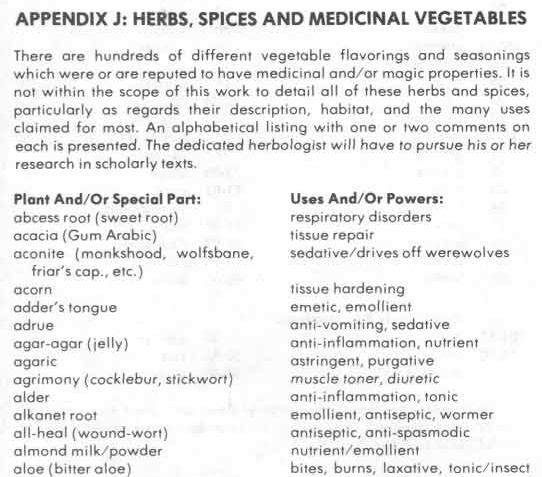
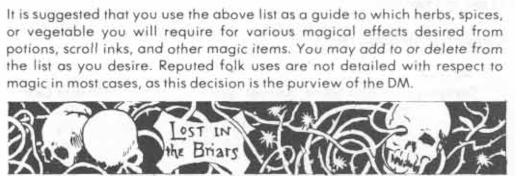
Among the lists and tables in the AD&D 1st edition appendices, Gary Gygax presents the Appendix J: Herbs, Spices and Medicinal Vegetables as a guide to substances which a Dungeon Master might assign in the creation of permanent or consumable magic items.[i] The absence of game mechanics per se and Gygax’s closing statement regarding “folk uses” of herbs supports the Appendix J’s intended purpose.
He does nevertheless leave such usage up to the DM’s discretion, and, as his prefatory advises, “the dedicated herbologist will have to pursue his or her research in scholarly texts.” The question then remains: which scholarly texts did Gary Gygax make use of when drafting Appendix J?
AD&D 1st edition, Dungeon Masters Guide
The Appendix J lists one-hundred seventy-one distinct substances in alphabetical order, often including alternate names in parentheses, each item with an accompanying comment on its uses or powers. At a first glance, the list suggests Nicholas Culpeper’s Complete Herbal as a possible reference text; and indeed, forty-seven of the items on the appendix list appear in Culpeper’s 17th century work.[ii] A reasonable starting place, as Culpeper’s work had since greatly influenced herbals published in English.
Maud Grieve’s 1931 A Modern Herbal instead provides us with one-hundred seventy of the appendix items, duly citing Culpeper as appropriate; and its entries generally exhibit a similar style of language on “medicinal uses” to the properties that Gygax condensed into his comments.[iii] The single odd-ball substance Gygax lists is muira-puama, of which we will speculate in the conclusion.[iv] Let us instead focus on a further analysis of the appendix text.
Rather than commenting on a substance’s uses or powers for ten items (bay leaf, cardamom, chervil, garden burnet, lotus, peppermint, poppy, spearmint, tarragon, and turmeric), Gygax simply gives a question mark.
Many of these entries in Grieve’s herbal tend to vary from a standard or easily condensable description. The mints are all listed together, for example, as are varieties of cardamom. Lotus in Grieve is entered as White Pond Lily—though a subtextual relation to Robert E. Howards work is tempting to identify. In Grieve, the Red Poppy shows no special properties, whereas the White Poppy, of course, is a narcotic. And tarragon’s medicinal use in Grieve might perhaps best be condensed as a “cure for toothache” and “liver.”
Equipment Tables from OD&D, AD&D 1e, and Arduin
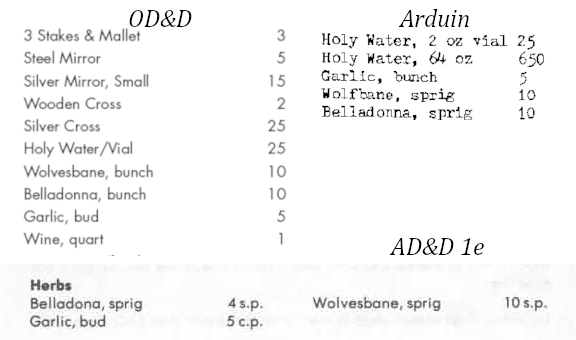
While it’s challenging to ascertain why Gygax may have left those ten items without comment, he did provide specific narrative functions to the traditional “holy trinity” of OD&D[v] and AD&D[vi] “basic equipment” herbs (wolfsbane, belladonna, and garlic); and a curious addition of chives (evil eye) and rosemary (drives off evil spirits). Grieve cites rosemary’s use as “a safeguard from witches and evil influences.” As for chives, its appendix comment may very well have come from the plant’s popular association of onions and garlic with such matters as warding off the evil eye, and neither Grieve nor Culpeper have anything to say of that matter.
AD&D 1st edition, Dungeon Masters Guide
This brings us back to muira-puama, a rather unique entry on the appendix list. Considering Gygax’s wide reading, or perhaps his anthropological studies, the source may very well have been from an ethnological journal as from a passing mention in Playboy magazine. Muira-puama is one of two items in the appendix that list “aphrodisiac” as a power—juniper is the other item, and neither Culpepper nor Grieve attribute to juniper any aphrodisiacal qualities (rather, they mention juniper as a type of emmenagogue). This may provide a clue for future investigation, but as of now, Gygax’s source or reason for including muira-puama remains a mystery.
Many years later Gary Gygax would write his World Builder and include in it a list of flora, incorporating much of the Appendix J items—leaving out muira-puama—, many additional organic substances, and accompanying reputed symbolic meanings.[vii]
Bunnies & Burrows in 1976 provided an herb list with game effects,[viii] and 1977’s Chivalry & Sorcery presented an extensive list of organic compounds for purchase from an apothecary (including, of course, Black Lotus).[ix] The Arduin Grimoire provided the usual “holy trinity” of garlic, belladonna, and wolvesbane in 1977,[x] even retaining the same numerical list price as OD&D (later corrected to a silver price rather than gold in Arduin, vol 2),[xi] although using a variant spelling of wolvesbane as wolfbane. And later, in 1982, Rolemaster would present players with a comprehensive list of magical, fantasy herbs for use.[xii]
Indeed, although a list of herbs for use in roleplaying games is by no means exceptional, it yet remains an uncommon thing for game designers to include. Even the “holy trinity” of equipment list herbs has fallen off of D20-era Pathfinder’s and D&D’s adventuring gear. Perhaps someday, such lore and narrative potential once again revives in roleplaying literature. In the meantime, as far as this research concludes, Gygax’s immediate primary source for the Appendix J list appears be Maud Grieve’s A Modern Herbal, and well may her work provide future campaigns with a wealth of material.
[i] Gygax, Gary. Dungeon Master’s Guide. TSR, 1979.
[ii] Culpeper, Nicholas. The Complete Herbal. Kelly, 1850.
[iii] Grieve, Maud. A Modern Herbal. Dover, 1971.
[iv] Ptychopetalum. Wikipedia, The Free Encyclopedia. Retrieved 00:19, August 28, 2022.
[v] Gygax, Gary and Dave Arneson. Dungeons & Dragons: Men & Magic. Tactical Studies Rules, 1974.
[vi] Gygax, Gary. Players Handbook. TSR, Inc., 1978.
[vii] Gygax, Gary and Dan Cross. Gary Gygax’s World Builder: Gygaxian Fantasy Worlds Vol. 2. Troll Lord Games, 2003.
[viii] Sustare, B. Dennis and Scott Robinson. Bunnies & Burrows. Fantasy Games Unlimited, 1976.
[ix] Simbalist, Edward and Wilfried Backhaus. Chivalry & Sorcery. Fantasy Games Unlimited, 1977.
[x] Hargrave, David. The Arduin Grimoire. Hargrave, 1977.
[xi] Hargrave, David. The Arduin Grimoire, Vol. 2. Hargrave, 1978.
[xii] Charlton, S. Coleman and Peter Fenlon. Character Law. Iron Crown Enterprises, 1982.
 Appendix N Plus