And we return from the stacks with a few painted leaves in hand.
“The Sign of Chaos flashed on their sails, eight amber arrows radiating from a central hub—signifying the boast of Chaos, that it contained all possibilities whereas Law was supposed, in time, to destroy possibility and result in eternal stagnation. The sign of Law was a single arrow pointing upwards, symbolising direction and control.” – Stormbringer, Michael Moorcock[i]
The signs of Chaos and Law are perhaps the most recognized among devices borne by protagonists within the Appendix N corpus.
“He looked down at the great, round shield with its shifting amber arrows and its mysterious silver-green colour. He picked it up easily enough and placed it on his arm. It virtually covered his body from chin to ankles.” Stormbringer, Michael Moorcock
The earliest extant depiction in print of the sign of Chaos appears in the Stormbringer graphic novel of 1976.[ii] TSR would soon illustrate the signs of Chaos and Law in the first printing of Deities and Demigods (1980).
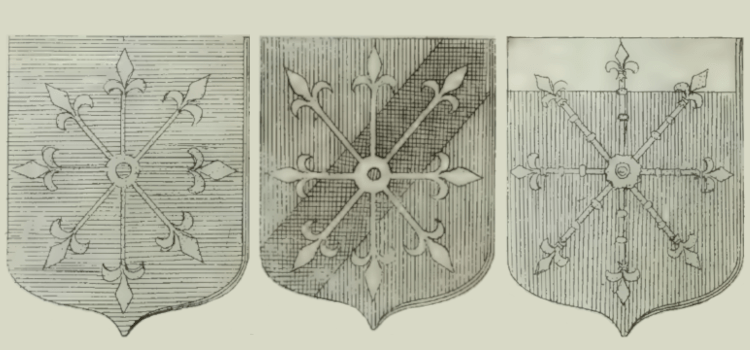
Moorcock describes the Sign of Chaos as ‘eight arrows radiating from a central hub,’ resembling more a heraldic escarbuncle charge than those illustrations in which the lines of the arrows simply intersect.
Examples of Escarbuncles, from Tesserae gentilitiae[iv]
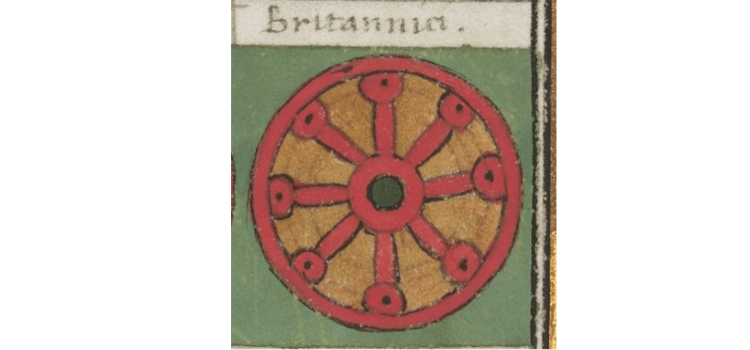
There is also passing resemblance to Legio Britannia Secunda’s shield device as given in the Notitia Dignitatum.
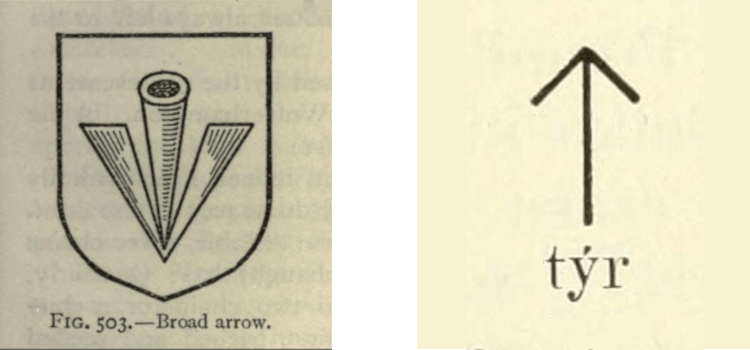
Arrows and spears are common enough charges in Western heraldic art, with the Pheon or Broad arrow variant most closely approximating the usual directional arrow representations of the Sign of Law.
Broad arrow from A Complete Guide to Heraldry, Fox-Davies,[vi] and Týr rune from Rycerstwo polskie wieków rednich, Piekosiski[vii]
Polish heraldic art makes frequent use of the basic form, as the strzała and rogacina charges, themselves stylized bar characters of arrow and arrowhead. Note also a resemblance between the Sign of Law and the Futhark t-rune, which letter derives from an ideograph for a spear.
Arrowhead variants from Heraldyka polska wieków średnich, Piekosiński[viii]
and Tablice odmian herbowych Chrząńskiego, Ostrowski[ix]
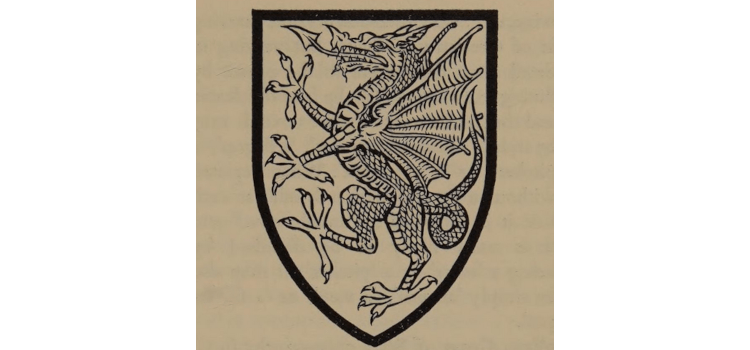
“Resting on the deck against the golden rail of the bridge was the great round warboard, his shield, bearing the sign of the swooping dragon.” – Elric of Melniboné, Michael Moorcock.
Elric, too, bore his own coat of arms, described as a swooping dragon.
A dragon segreant wings elevated, from An Encyclopaedic Dictionary of Heraldry, Franklyn[x]
“Turning, Hawkmoon recognized the insignia on the man’s coat as his own, the arms of Koln.”
And although he does not specifically describe it, Moorcock names Dorian Hawkwind’s coat of arms as those of Koln.
“Count Brass ordered his herald forward, and the men approached, bearing the simple flag of his master – a red gauntlet on a white field.” – The Jewel in the Skull, Michael Moorcock
The red slate roofs and scarlet flamingoes of the Kamarg, Count Brass’s bronze tan “glowing red,” this larger-than-life hero’s strength and protection, all find their thematic echo in his armorial bearings.
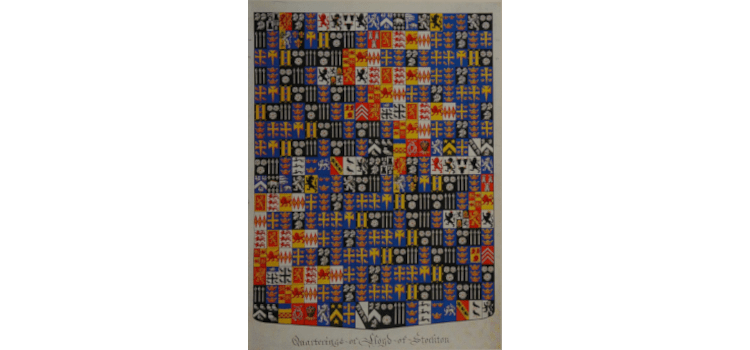
“Count Brass looked hard at the carriage. […] On the doors was an elaborate coat of arms displaying many quarterings in which were strange-looking animals, weapons, and symbols of an obscure but disturbing nature. Count Brass recognized the design of the carriage and the coat of arms. The first was the workmanship of the mad smiths of Granbretan; the second was the coat of arms of one of that nation’s most powerful and infamous nobles.” – The Jewel in the Skull, Michael Moorcock
In stark contrast with Count Brass’s simple device, the elaborate, many-quartered coat of arms of Baron Meliadus readily illustrates the anxious, fanatic decadence of Granbretan.
The Quarterings of Lloyd of Stockton, an extreme example, from The Oxford Guide to Heraldry, Woodcock[xi]
“… memories going back to my childhood in the great palace of Amber, with the green banner of my father Oberon flaring above it, white unicorn rampant, facing to the dexter.” – Nine Princes in Amber, Roger Zelazny
Zelazny’s chronicles of Amber abound with color and symbolism. Corwin’s personal colors thread black and silver through his memories until he reclaims them walking the Pattern, finally recalling the Sign of the Unicorn, the arms of his father Oberon.
A unicorn rampant, from The Art of Heraldry, Fox-Davies[xii]
“When I was dry again, I was given fresh garments, of black and of silver. I donned them, and a black cloak was hung about my shoulders, its clasp a silver rose. ‘You are ready,’ said the sergeant of the guard. ‘Come this way.’” – Nine Princes in Amber, Roger Zelazny
We turn now a few idle leaves in the ancient histories of our hobby and peruse some of those marks of distinction called armorial bearings or coats of arms.
‘Yes, I seek a man.’ Carahue’s eyes were shrewd above the rim of his goblet. ‘Mayhap you’ve heard news of him? A big fellow, about your size, but yellow-haired. Most likely he’ll ride a black stallion and bear arms either of an eagle, sable on argent, or of three hearts sanguine and three lions passant or.’ – Three Hearts and Three Lions, Poul Anderson[i]
Although it has lately fallen out of fashion, the heraldic art has long graced the pages of tabletop roleplaying and its immediate wargaming predecessors. From 1970 through 1971, the Castle & Crusade Society’s newsletter, The Domesday Book,[ii] included such material in no less than four issues, in April, June, July 1970 and April 1971. Gygax and Perren also included examples of heraldic art as illustration in Chainmail. Later, in 1980 and 1983, the World of Greyhawk enriched its setting material with many more examples. Heraldry likewise embellishes the pages of the Appendix N and the sources upon which those writers drew.
from Chainmail, 2nd edition
Although not depicted with any tincture to aid in identification, the coats of arms in Chainmail[iii] present well-recognized charges. For the eagle displayed, the obverse of the great seal of the United States on the reverse of any dollar bill is a familiar sight, among other specimens.
from the Great Seal of the United States of America; Fox-Davies’ Complete Guide[iv]
For the three lions passant guardant, three fleurs-de-lys two and one, and the three ancient crowns two and one, the royal arms of England, France, Denmark, and Sweden together present suitable models.
Erik of Pomerania, Canute IV, from Nordic Antiquities and History[v]
The Black Prince, Edmund Langley, from Eve’s Heraldry as Art[vi]
English Royal Arms, from Friar’s Basic Heraldry[vii]
The shield was of conventional heraldic form, about four feet long, and obviously new. When he took the canvas cover off its surface, which was a thin steel overlay on a wooden base, he saw a design of three golden lions alternating with three red hearts on a blue background. A dim remembrance stirred in him. He stood puzzling for a while. Was this… wait. The Danish coat of arms. No, that had nine hearts. The memory sank down again. – Three Hearts and Three Lions, Poul Anderson
cover of 1961 printing
Within the Appendix N exist numerous examples of the heraldic art. The most prominent of which is Poul Anderson’s Three Hearts and Three Lions, with the description of Holger’s coat of arms furnishing the title. As in the primary sources on which Anderson draws, the use of armorial bearings identifying a character—and either their identity or mistaken identity—often features in the narrative.
Afterward he [Carahue] and Holger checked what equipment they had. His armor was a steel corselet, flaring at the shoulders and elaborately arabesqued; a spiked helmet with chainmail earflaps; greaves atop boots of tooled leather. His shield bore a six-pointed star argent on a field azure, border gules fleury or; his weapons included a bow and arrows; he rode a slim white mare. – Three Hearts and Three Lions, Poul Anderson
While primary sources do not describe Ogier the Dane’s armorial bearings, Anderson models Holger’s on the Danish coat of arms.[viii]
illustration, Holger Danske
Of the many secondary sources narrating the life of Ogier the Dane, those of Bulfinch, Lang, and Hans Christian Andersen have perhaps been the most popular among English readers. Poul Anderson’s most direct model for Holger’s arms appears to be in Han Christian Andersen’s fairy tale of Holger Danske.
And the old grandfather nodded again; and the more he looked at his Holger Danske, the more obvious it was to him that he had carved a good figure,—nay, it even seemed to him as if it assumed the colour of life, and as if the armour glittered like iron and steel: the nine hearts in the Danish arms seemed redder and redder, while the lions, with their gold crowns on their heads, were actually leaping.
‘They are certainly the finest arms in the world,’ said the old man. ‘The lions stand for strength, and the hearts for mercy and love.’ And he gazed at the uppermost lion, and thought of King Knut, who chained illustrious England to the Danish throne; and he looked at the second lion, and thought of Waldemar, who united Denmark, and conquered the Vandal states. Then he looked at the third lion, and thought of Margaret, who was the bond of union between Denmark, Sweden, and Norway. But while he was gazing at the red hearts, they glowed yet more brightly than before, and became flames that moved, and his mind followed each of them in turn. – The Fairy Tales of Hans Christian Andersen[ix]
Indeed, Andersen’s grandfather specifically describes the attributes of three lions and of three hearts only, somewhat different than the incompletely carved, quartered arms shown in his text’s illustration.
“Right now he had to keep alive in a land where a good many beings had it in for one who bore three hearts and three lions.” – Three Hearts and Three Lions, Poul Anderson
Our adventures will soon continue into the world of Greyhawk and even deeper into the Appendix N Plus wilderness!
[viii] Holger is the protagonist of Anderson’s Three Hearts and Three Lions. Through primary and secondary sources he is called variously Holger Danske, Ogier the Dane, Oddgeir Danski, etc.
It is high time that we turn a page or four in the Appendix N, with Tolkien, Anderson, Dunsany, and Moorcock, the Appendix’s last extant, living author.
“Naturally, the origin of each sword is either Law, Neutrality, or Chaos, but some of these weapons are forged by more powerful forces for an express purpose.”
In our contemporary age, in which magic items proliferate in fantasy realms like so many mass-produced mundanities, such a statement, presented in D&D, vol. II, Monsters & Treasure, should sound strange and foreign. And well it should. The statement depends upon a milieu in which a sword’s uniqueness, or at least its purpose, and its alignment are integral factors. And although it is tempting to go into a deeper exploration of Moorcock and Anderson’s influence on alignment in roleplaying gaming, we’ll save that for another day, and this adventure we will pursue instead the legend of the magic sword in the Appendix N.
from Handbook of the old-northern runic monuments of Scandinavia and England
“Magical Swords: Because these weapons are almost entities in themselves, they accrue real advantage to the figure so armed. In normal combat they merely add an extra die. It is in fantastic combat the Magical Swords are most potent.”
Chainmail 2nd edition
The magic sword is present already in Gygax’s earliest tabletop fantasy material. Magical swords and enchanted arrows comprise the two specific kinds of magical weapons detailed in the Chainmail fantasy rules.[i] Described as “almost entities,” magical swords shed light and dispel darkness. Arneson would later claim that the “nature and powers” of his own swords came from the pages of Chainmail.
“Prior to setting up Blackmoor, I spent a considerable effort in setting up an entire family of Magical Swords. The Swords, indeed comprise most of the early magical artifacts. … The Magic Swords of Mythology are varied creatures that can give great powers to their owners, who sometimes are helpless without them. Only Swords have these powerful variations and capabilities. Other weapons being relegated to lesser bonuses due to their shapes, that do not lend themselves to magical incantations.”
The First Fantasy Campaign
Thus, in the Blackmoor campaign, the magic sword also figured as the prominent magical weapon. Arneson described his family of magic swords and their special properties in The First Fantasy Campaign,[ii] and D.H. Boggs has conducted some research into the origins of the special characteristics which Arneson attributed to his swords.[iii] Interestingly, and expanding from Chainmail, a sword bearer’s alignment was a factor for Arneson, as Greg Svenson attested, “Dave’s perception of our alignment, as it is called now, affected whether we were able to hold the magic sword we found during that first adventure.”[iv]
“SWORDS: Among magic weaponry swords alone possess certain human (and superhuman) attributes; Swords have an alignment (Lawful, Neutral, or Chaotic), an Intelligence factor, and an egoism rating (as well as an optional determination of their origin/purpose).”
D&D, vol. II, Monsters & Treasure
In 1974, Dungeons & Dragons formalized the myth of the magic sword, assigning not just alignment, but also individual personality and attribute scores to its magic swords exclusively.[v] Other miscellaneous, magic weapons gave a bonus to hit and damage (with some exceptions) and included mace, axe, bow, arrows, daggers, spears, and hammers. These miscellaneous magic weapons however did not demonstrate any personality, and with the exception of a hammer and couple of daggers, neither did they exhibit any special powers or abilities.
“Most players will be unwilling to play swords with personalities as the personalities dictate.”
Players could find their characters at odds with their sentient swords at inopportune times, even when their alignments were otherwise compatible. Sentient swords, being intelligent and willful, might very well lead their bearers past better weapons or require a share of treasure. At other times, the influence of a sentient sword might prove more nefarious than simple jealousy or greed if its origin and purpose so dictated. And by the advent of AD&D, not every sword would necessarily exhibit sentience. Yet, except for certain artifacts, sentience was still the strict domain of swords, those few and unusual creations imbued with primary abilities, extraordinary powers, or a purpose.
“Swords: An Ego sword is a blade literally possessed by a type of Demonic force. The personality of the sword (IQ, Wisdom, Alignment) is determined as for a person. It will invariably seek glory in battle, and if its combined IQ and Wisdom are ever higher than its owner’s, it will lead him into danger to test his worthiness to own such a fine weapon and to gain the opportunity of slaying enemies. Ego swords are intensely jealous of any other swords the owner may possess, especially magical swords.”
Chivalry & Sorcery
The concept of the sentient sword was also present in other early roleplaying games, such as 1977’s Chivalry & Sorcery, where they existed side-by-side other types of enchanted arms and armor created by Artificers.[vii]
“Most swords (and all daggers) of magical nature shed light when drawn from their scabbard.”
AD&D, Dungeon Masters Guide
With few exceptions, in Chainmail fantasy rules, D&D, and AD&D, magic weapons were all depicted as shedding light when drawn. There is certainly precedence for such in fantasy literature, as in Tolkien, with those blades forged in Gondolin shedding light under certain circumstances, as might other magic weapons.
“Desperate, [Frodo] drew his own sword, and it seemed to him that it flickered red, as if it was a firebrand. Two of the figures halted. The third was taller than the others: his hair was long and gleaming and on his helm was a crown. In one hand he held a long sword, and in the other a knife; both the knife and the hand that held it glowed with a pale light.”
The Fellowship of the Ring, Book 1, Chapter 11, A Knife in the Dark[viii]
“[Frodo] drew out Sting: it flashed and glittered like a blue flame and then slowly faded again and grew dull.”
The Fellowship of the Ring, Book 2, Chapter 6, Lothlórien
And so, too, would Moorcock’s Stormbringer shed light under certain circumstances, though of a different aspect.
“Almost at its own volition the huge runesword sprang from its scabbard and black light poured from its blade as it began to hum its own strange battle-cry.”
Stormbringer’s power of stealing souls has been rendered in rules beginning with D&D’s “Life Energy Draining” ability, and later revised in AD&D as “Life Stealing,” although the runesword’s powers and character have appeared more explicitly elsewhere in fantasy gaming.
“Blackrazor is a negative-energy entity that exists by absorbing positive life energy levels from those it kills. […] Blackrazor exists solely to feel power and souls coursing through itself, and sometimes it may not be too picky about where the energy is coming from.”
“‘Wormbrand Soulstriker’, who is actually a type IV demon in eternal service to the lord. Wormbrand’s sole purpose in ‘life’ is to provide the demon with life energy by stealing the souls from humans.”
The Book of Treasure Maps, Scenario Four: Willchildar’s Well[xi]
“SOUL CLEAVER: This sword is always CHAOTIC. The sword will eat the souls of those it hits in combat. Unless the victim makes his saving throw he is a soulless dead hulk.”
There is more than passing similarity between Anderson’s description of Tyrfing in The Broken Sword and Moorcock’s description of Stormbringer.[xv]
“Still Stormbringer sang its sinister battle-song and still the runesword passed its power to its master so that with every death Elric found strength to slay more of the soldiers.”
“Yet this is the curse on it: that every time it is drawn it must drink blood, and in the end, somehow, it will be the bane of him who wields it.”
The Broken Sword
“…and the runes in Alveric’s far-travelled sword exulted, and roared at the elf-knight…” […] “And no more shock came to him from any of those swords, but only a vibration in his own sword’s metal that passed through it like a song, and a kind of a glow that arose in it, reaching to Alveric’s heart and cheering it.”
“And the savage, lusting sword that had thirsted for a hundred years went up with the hand of Rold and swept through a tribesman’s ribs…. And there arose the sounds of the exulting of victorious men, and the panting of those that fled, and the sword singing softly to itself as it whirled dripping through the air.”
Such similarity runs through Dunsany, Anderson, and Moorcock’s description of their fated swords, familiar phrases and images often echoed or repeated like a refrain.
“Earth clung damp to the halves of the broad blade. It had been two-edged, and so huge and heavy that only the strongest of men could readily wield it. […] Runes that Skafloc could not read went down the dark blade. He had the feeling that the mightiest of these were hidden on the tang.”
The Broken Sword
“Can you not sense it? The power and hunger locked in that steel, held by those unknown runes. The sword may be from the gods, but it is not of them. There is a curse on it, Skafloc. It will bring the bane of all within its reach.”
The Broken Sword
Compare, too, these scenes from the Saga of Hervör and Heithrek and Anderson:
“She could now see the fires of the barrows and the ghosts standing outside; and she approached the barrows fearlessly and passed through the fires as if they had been merely smoke, until she reached the barrow of the berserks. Then she cried: Awaken, Angantyr, hearken to me! The only daughter of Tofa and thee Is here and bids thee awake! Give me from out the barrow’s shade The keen-edged sword which the dwarfs once made For Svafrlami’s sake.”
Stories and Ballads of the Far Past, Saga of Hervör and Heithrek[xix]
“The fire roared taller. The wind shrieked like a lynx and clouds swallowed the moon. Skafloc cried out: Waken, chieftains, fallen warriors! Skafloc calls you, sings you wakeful. I conjure you, come on hell-road. Rune-bound dead men, rise and answer! The barrow groaned. Higher and ever higher raged the icy flame above it.”
The Broken Sword
Tolkien as well provided his protagonists with magic blades from a barrow early in their career.
“For each of the hobbits he chose a dagger, long, leaf-shaped, and keen, of marvellous workmanship, damasked with serpent-forms in red and gold. They gleamed as he drew them from their black sheaths, wrought of some strange metal, light and strong, and set with many fiery stones. Whether by some virtue in these sheaths or because of the spell that lay on the mound, the blades seemed untouched by time, unrusted, sharp, glittering in the sun.”
The Fellowship of the Ring, Book 1, Chapter 8, Fog on the Barrow-Downs
While Tolkien, Anderson, and Dunsany had already left their marks on literature before Moorcock, Gygax, and Arneson, their common sources were in an older tradition of literature.
“Called Angervadil, or grief-wader, sometimes, too, brother of lightning. […] Faint were the runes when the land was in quiet throughout all its borders; But when the followers of Hild were summoned, then were they burning Red as the comb of a cock when he fighteth. Lost was the warrior Who met, on the field of encounter, the blade with its red letters glowing.”
“Tyrfing had this characteristic, that whenever it was unsheathed it shone like a sunbeam, even in the dark, and could only be sheathed with human blood still warm upon it. Never did he whose blood was shed by Tyrfing live to see another day. It is very famous in all stories of the olden days.”
Stories and Ballads of the Far Past, Saga of Hervör and Heithrek
Magic arms and armor lie strewn through myth and legend—these companions of heroes of old, dusty artifacts of another, timeless age. Stormbringer may have guided the form of sentience, ego, will, alignment, and purpose magical swords assumed at the origin of gaming; and players may have shied away from such unpredictable companions given the choice. But ever longing, have fated rune-blades as Angervadil and Tyrfing thirsted to shake off the dust and shed light and blood once more.
“Smite your foemen – gods, giants, mortals, it matters not. The sword is loose and the end of the world comes nigh!”









 Appendix N Plus
