“Don’t touch that! You don’t know what forces you could unleash!” – Aleister Crowley to Grady McMurtry, attributed by Lon Milo DuQuette, in his Forward to The Book of Abramelin: A New Translation [i]
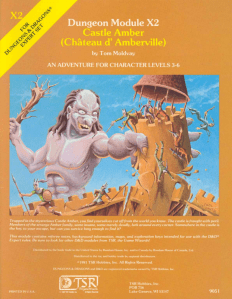
In this article we will examine the occult source material of dungeon encounter #46 in the 1981 Dungeons & Dragons module X2 – Castle Amber. We will not venture to explain any occult significance of the encounter, neither do we presume any occult intent in its design choice other than as thematic ‘dungeon-dressing.’
The influence of Clark Ashton Smith, Roger Zelazny, and Edgard Allan Poe in the module is readily evident. Other literary influences must include Baudelaire, “Flowers of Evil” (#22); Robert E. Howard, the narcotic black lotus (#50); and even a Norwegian Folktale, in the ‘Three Billy Goats Gruff’ encounter (#16).
A surreal weirdness permeates the module, and it includes several generic occult-themed encounters, such as the Demon of Death (#53) and the Card Room (#38).[v]
from X2 Castle Amber
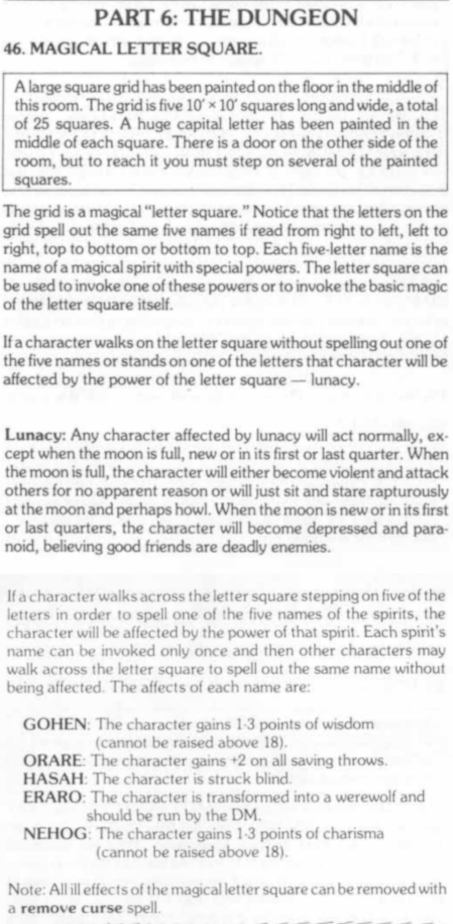
The Magic Letter Square (#46), the first room of the dungeon proper, presents a rather more unique and interesting encounter.
from X2 Castle Amber
The room description attributes several powers to the letter square, which may be ‘invoked’ either by traversing or standing on the square.[vi] In the encounter, the basic power of the square itself is lunacy, and, among beneficial effects, there are a couple of other possible ill effects, classified as curses, either blindness or lycanthropy.
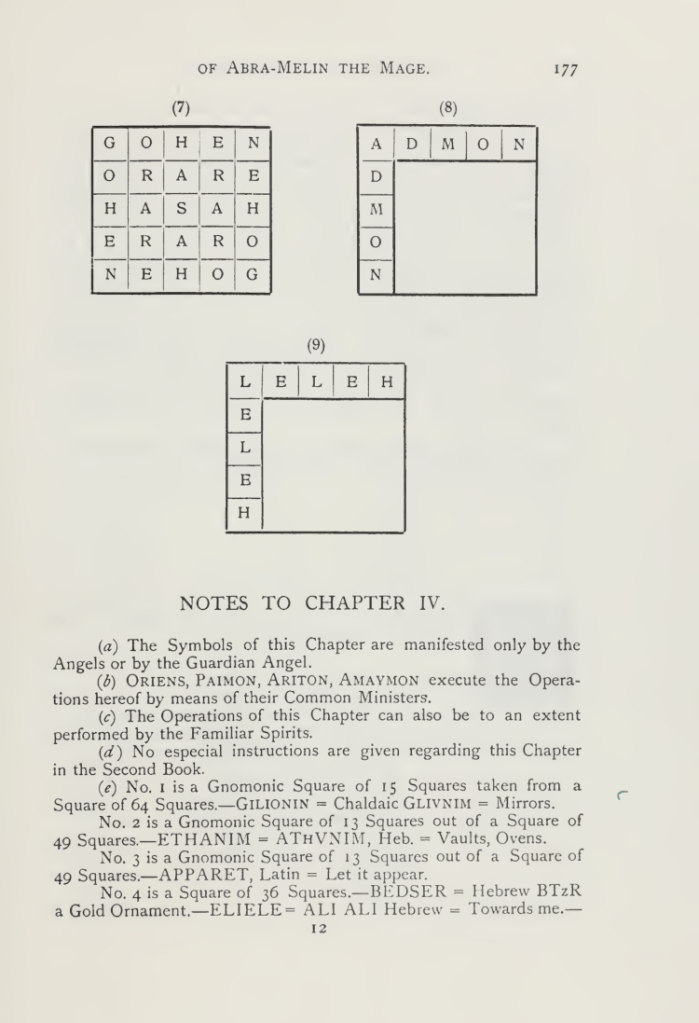
The form of this magic square is taken from The Sacred Magic of Abra-Melin the Mage, most likely S.L. MacGregor Mathers’ edition, which has been the only English-language translation available until quite recently. It is possible that there may have been another collection or encyclopedia of the occult used for reference as an intermediary text, but not necessarily so.
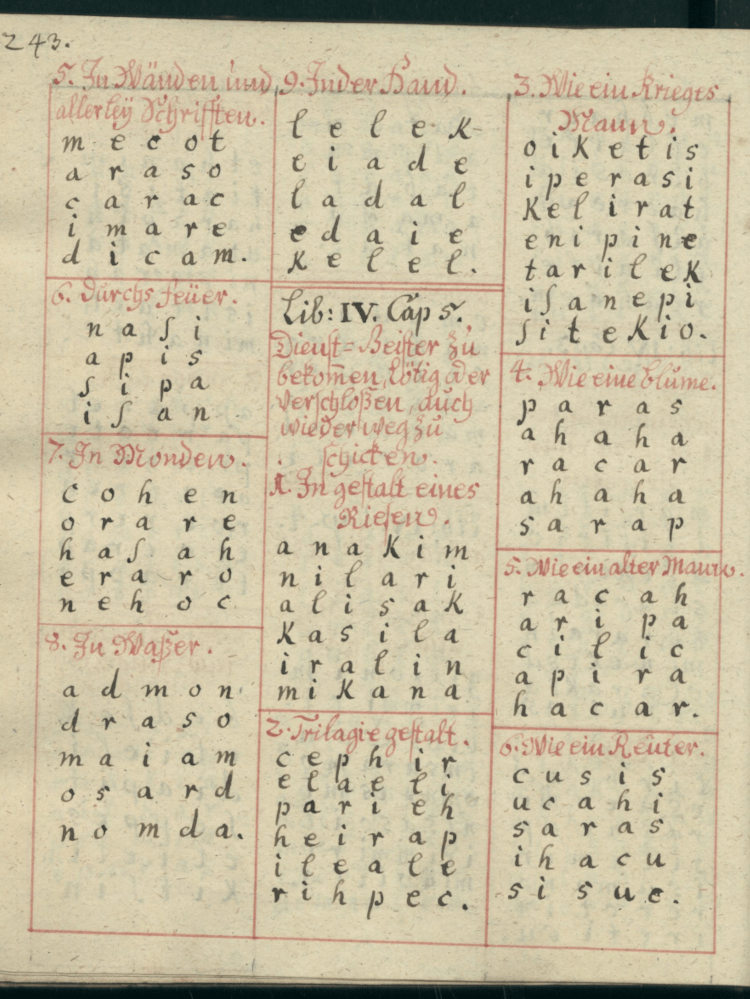
Pages from a French manuscript c.1750 at the Bibl. de l’Arsenal; and from the 1725 Peter Hammer edition
Mathers worked from an imperfect French manuscript—dated circa 1750—rife with errors, of which he was painfully aware.[viii] In his edition he reproduced the letters spelling GOHEN, although he commented in his notes that it should likely read COHEN. An earlier, German printing of the complete text—dated 1725—does give COHEN as the proper reading.[ix]
from the Dresden SLUB manuscript N 111 (c.1700)
An even earlier, circa 1700, German manuscript also appears intact and gives the spelling as COHEN for this square.[x] The earliest German manuscripts extant—no digital scan available—date from 1608 and are held at the Herzog August Bibliothek in Wolfenbüttel. [xi]
George Dehn, in his contemporary, critical edition, proposes that the attributed author, Abraham von Worms, is a pseudonym of the historical Rabbi Jacob ben Moses ha Levi Möllin, which would support an early 15th century composition.
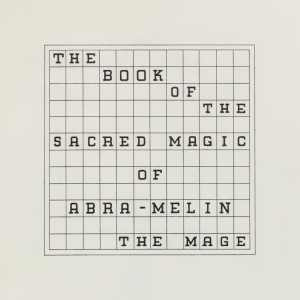
Half-title page from The Book of the Sacred Magic of Abra-Melin the Mage
The Abramelin text presents the magic word squares for use in dealing with spirits, and access to these abilities being earned only after great work. The COHEN or GOHEN square is intended for creating ‘visions in the moon.’ This textual association with the moon appears to be the only theme in common with the module’s assignment of the square’s powers to lunacy and lycanthropy.
Of course, the theme of traversing the magic square and running its risks to obtain some benefit suggests some similarity to traversing the Pattern in Zelazny’s Amber novels.[xii] As indicated at the beginning of this article, the module draws upon a wealth of literature, a testament as to how cultured and read was its designer.
“Nobody is born as a master—everyone needs to learn and to become a master—this is what happened to me and to everyone else. Engage yourself deeply in this study and you will be rewarded with experiences; the most shameful and disgusting title is ‘ignorant.’” – Abraham von Worms to his son Lamech, from the preface text to the 1608 manuscript, in Dehn’s edition
[i] Abraham von Worms. The Book of Abramelin: A new Translation. Edited by George Dehn, Translated by Steven Guth. Lake Worth, Florida: Iris Press, 2006.
[ii] Moldvay, Tom. Castle Amber. TSR Hobbies, Inc., 1981.
[iii] Portrait of Clark Ashton Smith. UC Berkely, Bancroft Library, By Unknown author, 1912.
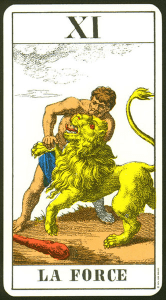
[v] The encounter’s description appears to describe cards from a Swiss (1JJ) tarot deck, excepting the hand positions of the Juggler card.
[vi] N.B. The room description, taken literally, would indicate spelling out GOHEN only when a character commences traversing the square from the East on the bottom row, as directionally that series of letters is at the bottom—south side—of the square, rather than at the top.
“The focus of interest in this study is more special: to trace man’s evolution as an artist and designer and to do this through the signs, seals and symbols he has left as his record.” – Ernst Lehner, “To the Reader,” Symbols, Signs & Signets
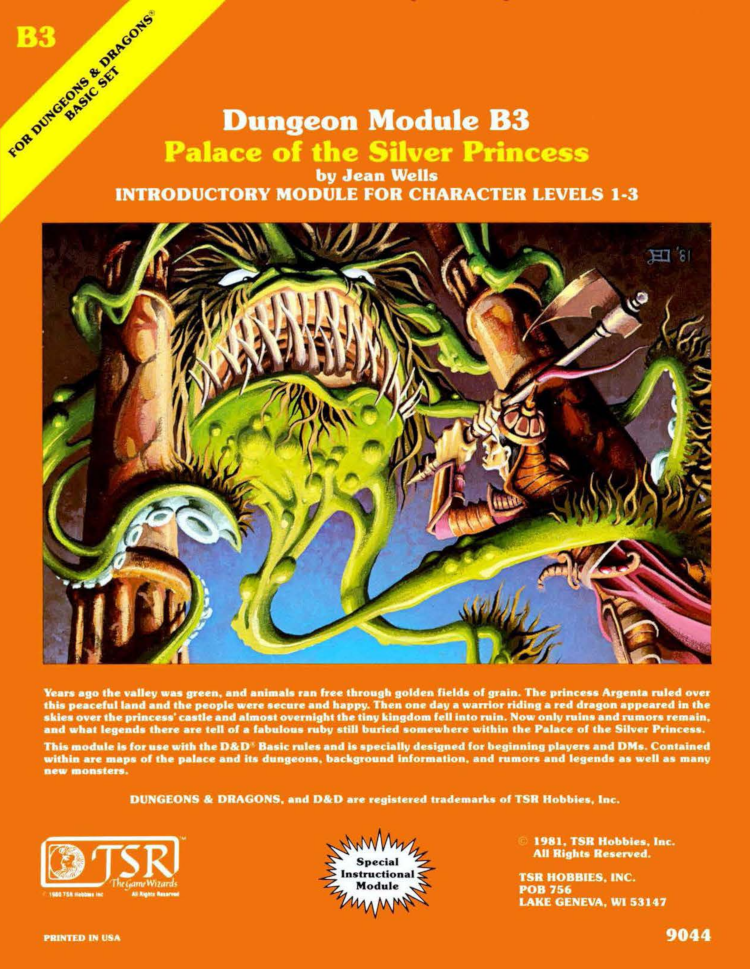
Covers of module B3 Palace of the Silver Princess [Orange] [i]and [Green] [ii]
In this article we will trace and identify the sources of some of the more obscure symbols used in illustrating the D&D module B3 – Palace of the Silver Princess. We will not venture to explain any occult significance of the symbols; and we presume there is no meaningful, occult intent behind choosing to include them in the module’s artwork. Neither will we be discussing the module’s history, which may be read over at the Acaeum.[iii] For our purposes, it’s enough to remark that the module underwent a complete revision from its original Orange-covered to its Green-covered form.
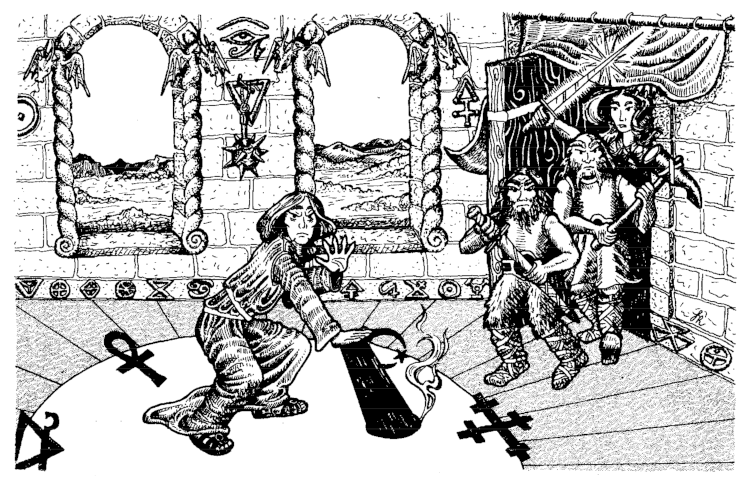
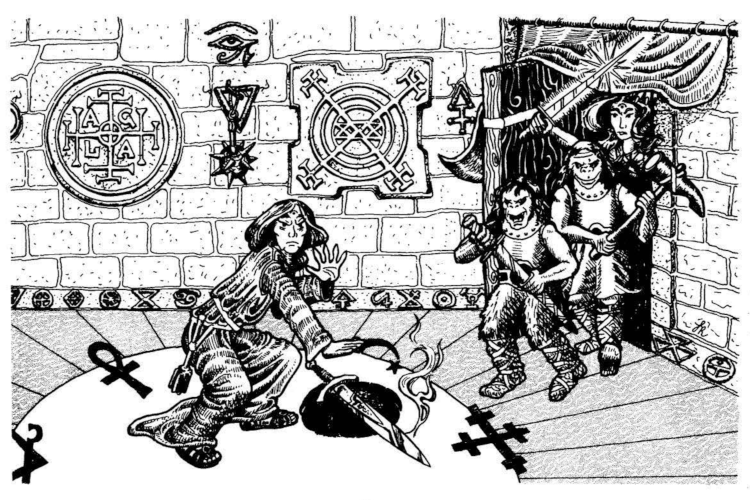
from B3 Palace of the Silver Princess [Orange]
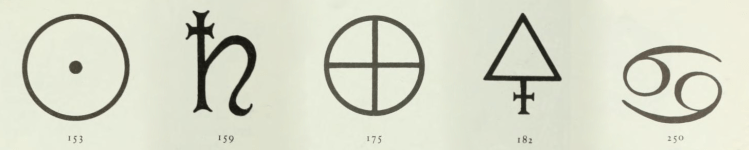
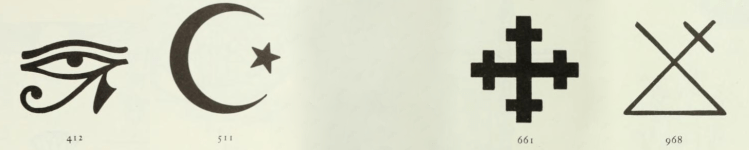
At first glance, it is evident that a preponderance of the smaller symbols on the walls and floor of this illustration have been derived from Lehner’s Symbols, Signs & Signets.[iv]
A selection of figures from Symbols, Signs & Signets
Collections of the kind were frequently mined for inspiration or material, literary or artistic; and Peterson has documented the influence of Lehner’s Fantastic Bestiary in Eldritch Wizardry (1976).[v] Here, the symbols are largely of a recognizable alchemical, astrological, and religious type.
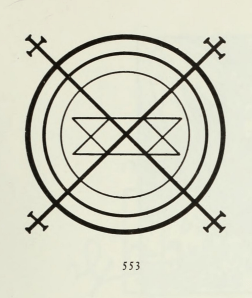
from B3 Palace of the Silver Princess [Green]
Of more interest is the change in illustration from Orange to Green versions of the module. In its original Orange-cover form, the chamber was an exterior-facing room of the palace with windows; and for the revised Green-cover form, converted into an interior room. The accompanying in-text descriptions are different. And, among other alterations to the artwork, the windows have been replaced with a couple of prominent symbols.
from Symbols, Signs & Signets, captioned BRINGS SUCCESS, WEALTH, LONG LIFE
Textual evidence indicates Lehner’s Symbols, Signs & Signets[vi] as the primary, immediate source here again, rather than his similar collection, The Picture Book of Symbols (1956)—namely, the absence of these two illustrations in the 1956 publication.[vii]
from Symbols, Signs & Signets, captioned THE HOLY MAGIC CIRCLE
Lehner’s bibliography is generally vague, more of a list of ‘works consulted,’ and the captions he has assigned to these two items, factitious at best. We can however trace their intermediate and ultimate sources.
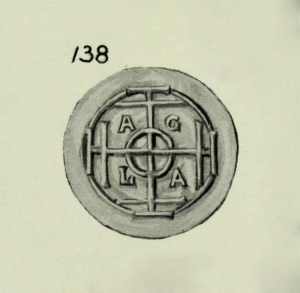
from The Book of Talismans, Amulets and Zodiacal Gems [viii]
Captioned as “Brings Success […]” by Lehner, he appears to have drawn it from William Pavitt’s Book of Talismans, Amulets and Zodiacal Gems, where Pavitt accurately identified the provenance of the figure with John Dee, though he in turn interpolated a significance of the AGLA acronym—i.e. use of the acronym as a medieval charm against Fever—alien to its usage by Dee.
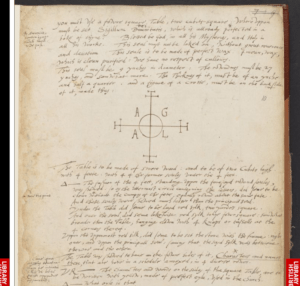
First recorded on March 10, 1582 in John Dee’s diaries, the ‘Seale with the figure of a Crosse […] made thus’ seems to be unique to Dee.
While there may be another intermediary source between Pavitt’s Book of Talismans and a printing of Dee’s notes, e.g. Mysteriorum Libri Quinque, Pavitt only appears to mention the AGLA acronym’s sometime use as a charm as an historical aside rather than as a specific description of Dee’s figure as illustrated.
In any case, the figure as eventually reproduced in Ernst Lehner’s collection ultimately originates with John Dee, who intended it to be used on the reverse of a large wax seal.[x]
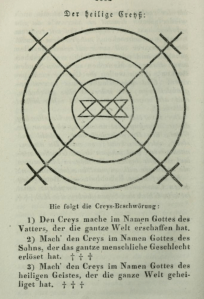
A twelve-volume collection of folklore, occult texts, and more, volume five of Johann Scheible’s Das Kloster contains a number of Faustian Höllenzwang.[xii] Ernest Lehner drew from this volume in particular, and his Symbols, Signs & Signets reproduces several figures from its pages.
The illustration above, drawn from the section entitled “Doctor Faustens dreyfacher Hoellenzwang,” is captioned as “Der heilige Creyß,” which Lehner would later rephrase as “The Holy Magic Circle.”
Scheible records the text as having been printed in Passau in 1407, somewhat before the historical Faust was born (c. 1480), and before the advent of Gutenberg’s printing press (c. 1436).
from Doctor Faustens Dreyfacher Hoellenzwang[xiii]
Narrowing our search, we find the earliest publication of this text—its use being still internally attributed to a Bishop Albrecht—in the collections at Heinrich-Heine-Universität Düsseldorf. Its catalog entry is titled Doctor Faustens Dreyfacher Hoellenzwang […].[xiv]
The archivist has identified a 1704 printing for the book, and the work’s typography supports an early 18th century printing. Some of the other, more complex illustrations within the text, later printed in Scheible, are here hand drawn.
John Dee, from Casaubon’s A True and Faithful Relation […] [xv]
And so, their provenance obscure, their meanings muddled over time as each successive author has reproduced or repurposed these illustrations, we have traced their descent from occult origins to D&D module B3 – Palace of the Silver Princess.
[i] Wells, Jean. Palace of the Silver Princess. TSR Hobbies, Inc., 1981.
[ii] Wells, Jean and Tom Moldvay. Palace of the Silver Princess. TSR Hobbies, Inc., 1981.
[ix] Dee, John. Sloane MS 3188f.10. British Library. Please note that of this writing, the British Library’s digital collections are still offline due to a cyber-attack. Black & White scans may be referenced HERE.
[xii] Höllenzwang, or Hoellenzwang, often translated as a “Coercion of Hell” or “Compulsion of Hell,” popular and usually anonymous texts, mostly originating during the 16th and 17th centuries.
“The impression made on memory will also be such as never afterwards to be obliterated; for the new art of memory is by association, … here the words and the pictures correspond as much as possible.” – Robert John Thornton, Illustrations of the School-Virgil
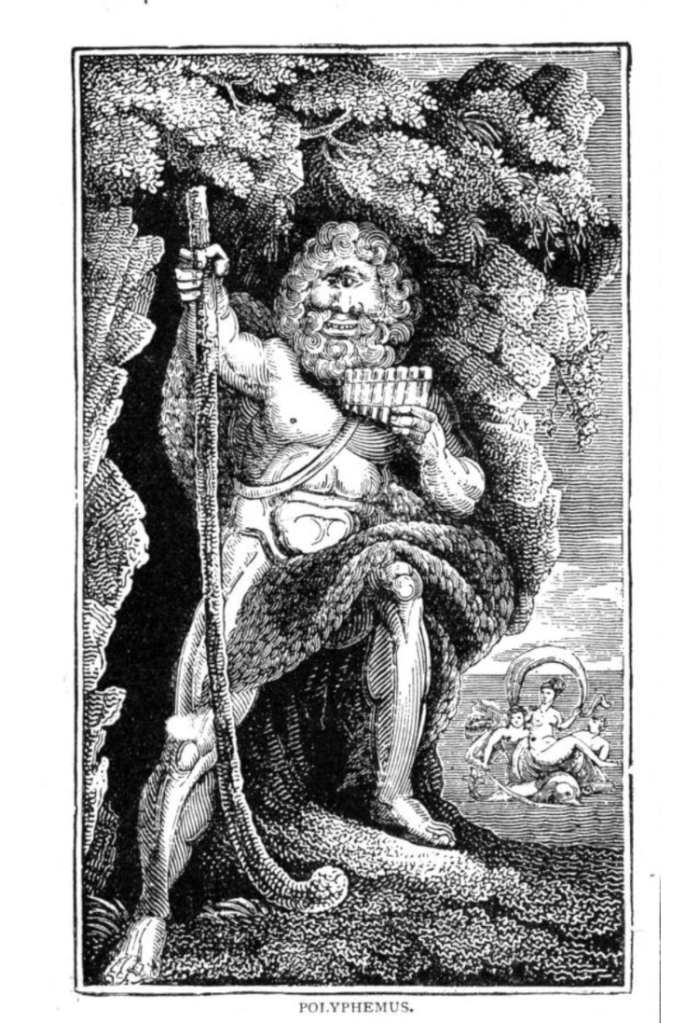
The title page of Supplement IV: Gods, Demi-Gods & Heroes (1976) presents the reader with an unattributed illustration depicting the cyclops Polyphemus and the sea nymph Galatea. The treatment follows the ‘unrequited love’ telling of their story in Theocritus’s 11thIdyll, [ii] rather than Ovid’s later version in Metamorphoses.[iii]
As with Supplement IV, the same illustration is rendered without attribution, caption, or comment in Tuer’s 1886 compilation 1,000 Quaint Cuts. Above is a digital scan of the 1968 reprint of this book which is held at the University of Illinois at Urbana-Champaign.[v]
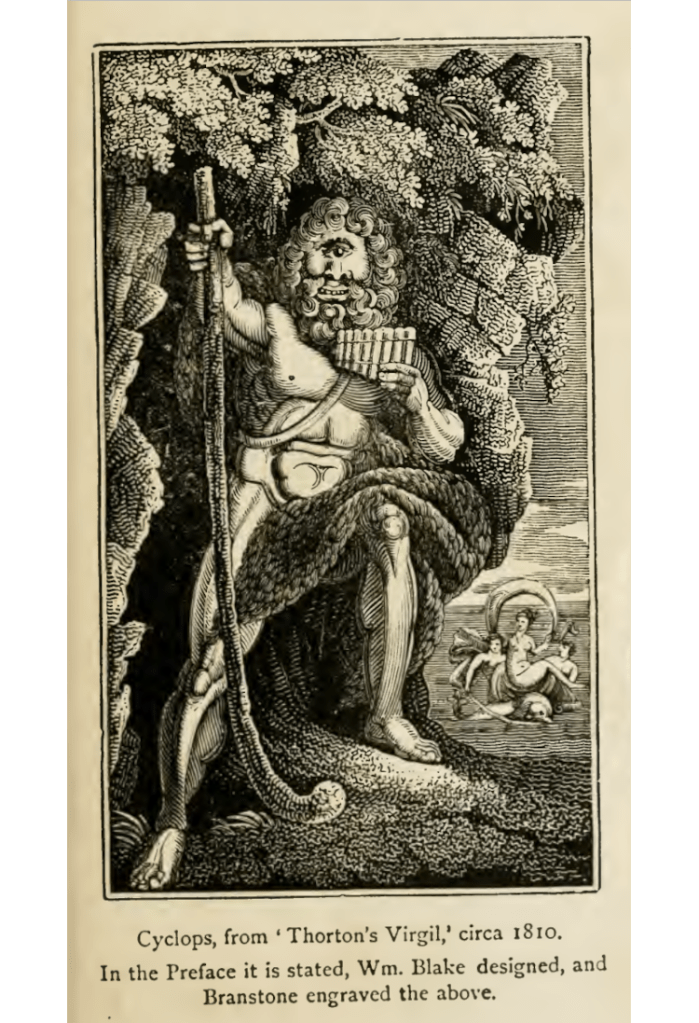
We find the same illustration reproduced in Pearson’s 1890 collection Banbury Chap Books And Nursery Toy Book Literature. Here, the editor has included a caption reading “Cyclops, from ‘Thorton’s Virgil,’ circa 1810. In the Preface it is stated, Wm. Blake designed, and Branstone engraved the above,” a description misstating critical information, as we will see below.
Finally, in 1892, The Strand Magazine also reproduces the illustration, this time identified as a “representation of Polyphemus, at the entrance to his cave, with cloak, staff, and Pandean pipes. The bold, free drawing of the King of the Cyclops is of the school of Blake, but there are points in the execution which diminish the probability of its being Blake’s actual work.” And which description again, except for accurately naming the cyclops as Polyphemus, perpetuates the misrepresentation.
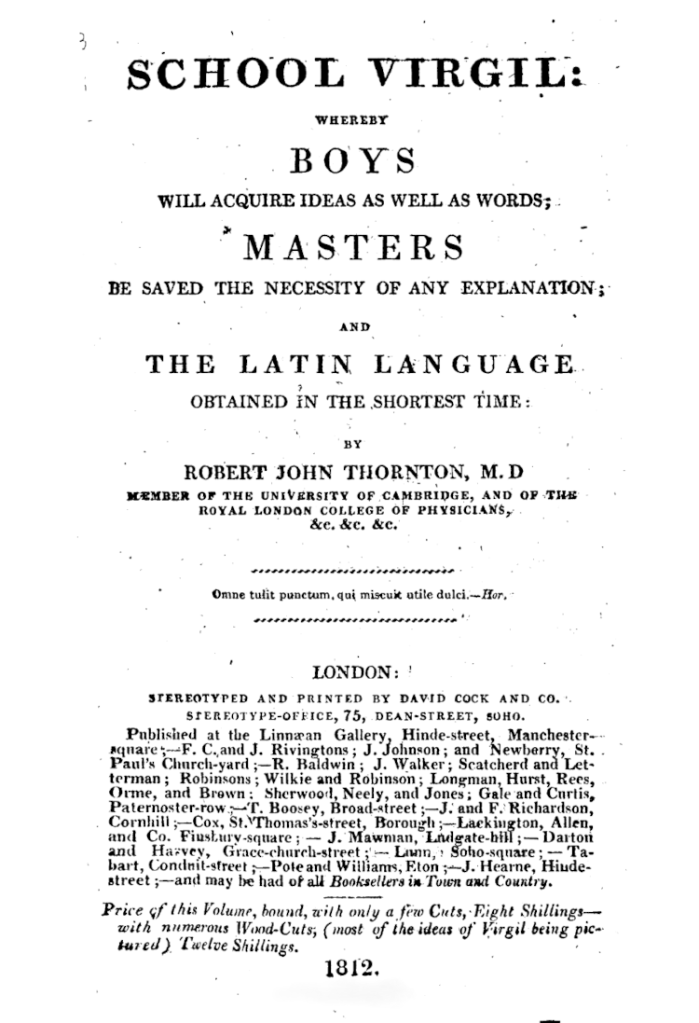
Title Page of Thornton’s 1812 School Virgil [viii]
The continuing misrepresentation in various reprints is understandable. Robert John Thornton’s “Virgil” went through three editions, in 1812, 1814, and 1821—and copies are scarce. The title page of the 1812 edition, stereotyped and printed by David Cock and Co., and titled School Virgil, is pictured above. In 1814, Thornton would later publish the supplementary Illustrations of the School-Virgil with F.C. and J. Rivington. That same year he would also publish through Rivington a second edition combining text and illustrations.[ix]
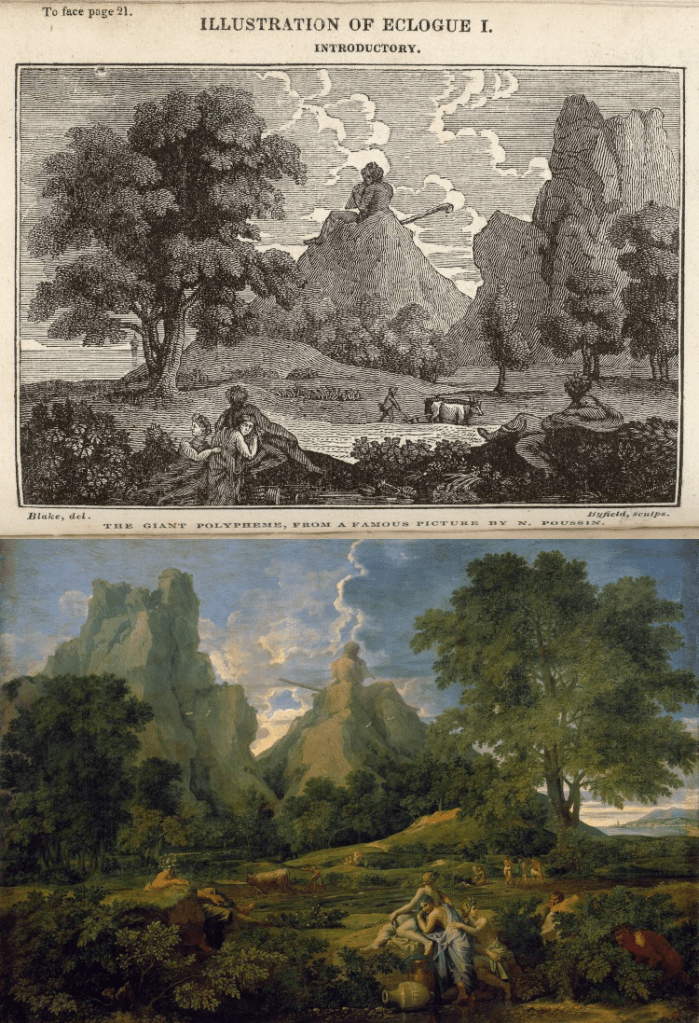
from The Pastorals of Virgil (1821) [x]; and Poussin’s Landscape with Polyphemus (1649) [xi]
In 1821, Thornton expanded and retitled the work as The Pastorals of Virgil. For this third edition he was able to engage William Blake through a mutual friend for a number of woodcuts and copper-plate engravings, and as designer of some illustrations executed by other hands. It is important to note that prior to this edition, the set of illustrations did not contain any by Blake, who was not engaged with the work until 1820.[xii]
The engraving above, captioned “Illustration of Eclogue I. The Giant Polypheme. From a Famous Picture by N. Poussin. Blake, del. Byfield, sculps.” mirrors Nicolas Poussin’s composition in “Landscape with Polyphemus” (1649).
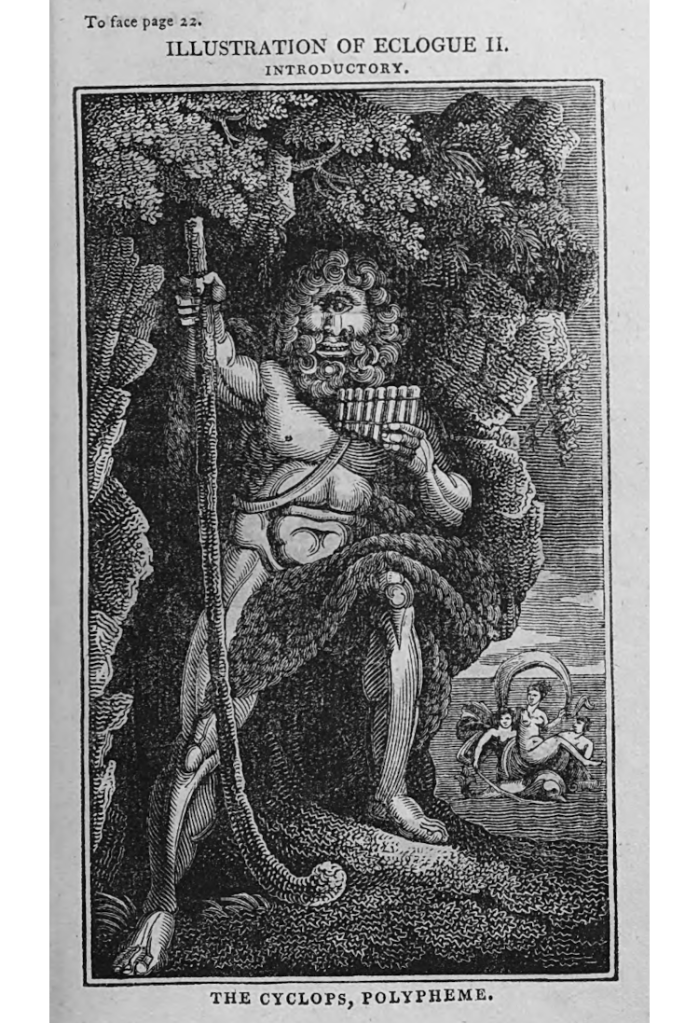
The Banbury reprint, other than misspelling the names of Thornton and Branston,[xiii] and The Strand both appear to have confused the above ‘engraving by Byfield[xiv] from a drawing by Blake of a figure of Polyphemus by Nicolas Poussin’[xv] with the original illustration of Polypheme below.
from Illustrations of the School-Virgil (1814) [xvi]
Captioned “The Cyclops, Polypheme” in the original 1814 Rivington print of Illustrations of the School-Virgil, the artist and engraver are still unknown.[xvii]
Several engravers and artists were involved in the set of original illustrations; however, the ‘Polypheme’ engraving does not appear reproduced in other available texts of the time by associated printers and publishers.[xviii]
In any case, where descriptions have accompanied reproductions of the original illustration, they perpetuated the same misrepresentation on down the line, confusing the engraving’s already murky origins.
As an interesting aside, among the artists who persuaded Thornton to include Blake’s unconventional woodblock engravings in the 1821 edition of The Pastorals of Virgil was the renowned English artist, James Ward (1769-1859).[xix]
[i] Ward, James, and Robert Kuntz. Dungeons & Dragons Supplement IV: Gods, Demi-Gods & Heroes. TSR Rules, 1976.
[ii] Theocritus; Bion; and Moschus. The Greek Bucolic Poets. Trans. J.M. Edmonds. London: W. Heinemann, 1912.
[iv] Tuer, Andrew W. 1,000 Quaint Cuts: from books of other days including amusing illustrations from children’s story books, fables, chap-books, &c., &c., A Selection of Pictorial Initial Letters & Curious Designs & Ornaments from Original Wooden Blocks Belonging to the Leadenhall Press. London: Field & Tuer, The Leadenhall Press, 1886; republished by Singing Tree Press, 1968.
[v] Curiously enough, the Urbana-Champaign copy has library due dates indicating it was checked out for most of April and May 1976.
[viii] Thornton, Robert John. School Virgil: whereby boys will acquire ideas as well as words, masters be saved the necessity of any explanation, and the Latin language obtained in the shortest time. London: Stereotyped and printed by David Cock and Co., Published at the Linnæan Gallery, 1812.
[ix] Sung, Mei-Ying. “Teaching History or Retelling Ancient Stories with Pictures: William Blake and the School Version of Virgil,” The European Conference on Arts & Humanities 2017 Official Conference Proceedings. Japan: IAFOR, 2017.
[x] Thornton, Robert John. The Pastorals of Virgil: with a course of English reading adapted for schools: in which all the proper facilities are given, enabling youtm [sic] to acquire the Latin language, in the shortest period of time: illustrated by 230 engravings. London: F.C. & J. Rivington, Stereotyped and printed by J. M’Gowan, 1821.
[xviii] Printing from stereotype plates was relatively rare in early 19th century Britain; by 1820 only a dozen printing firms in London did stereotyping. (“Andrew Wilson…”, from Jeremy Norman’s History of Information). Anastatic reproduction wouldn’t arrive until 1841.
“These prints were veritable treasures of learning. One could gaze at them for hours without experiencing any sense of weariness. Profoundly suggestive in reflections, they assisted Des Esseintes in passing many a day when his books failed to charm him.” – J.-K. Huysmans[i]
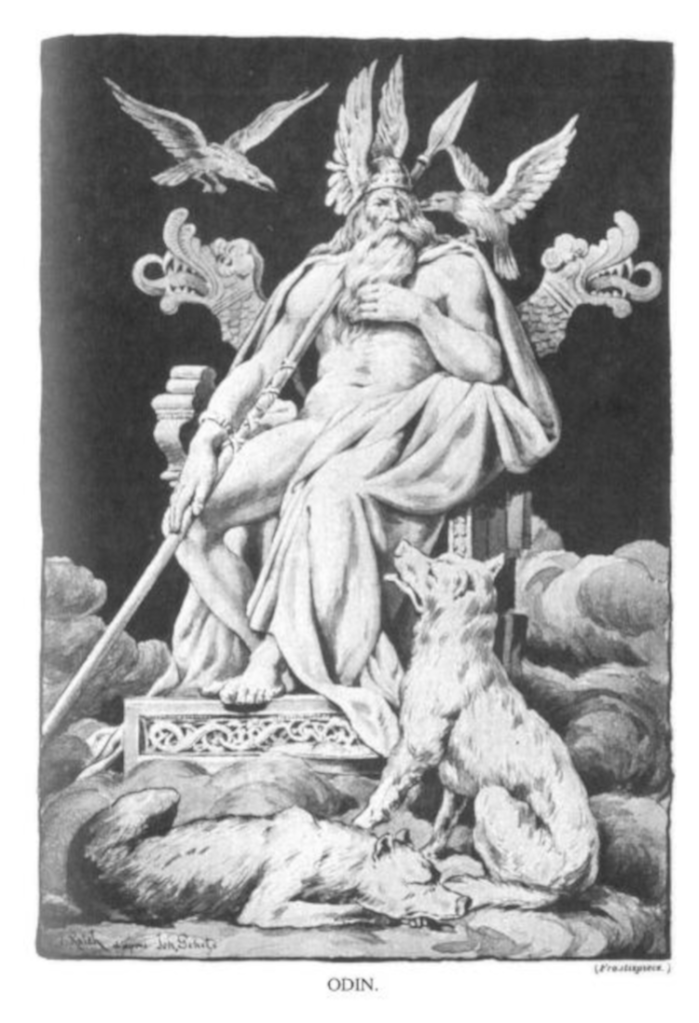
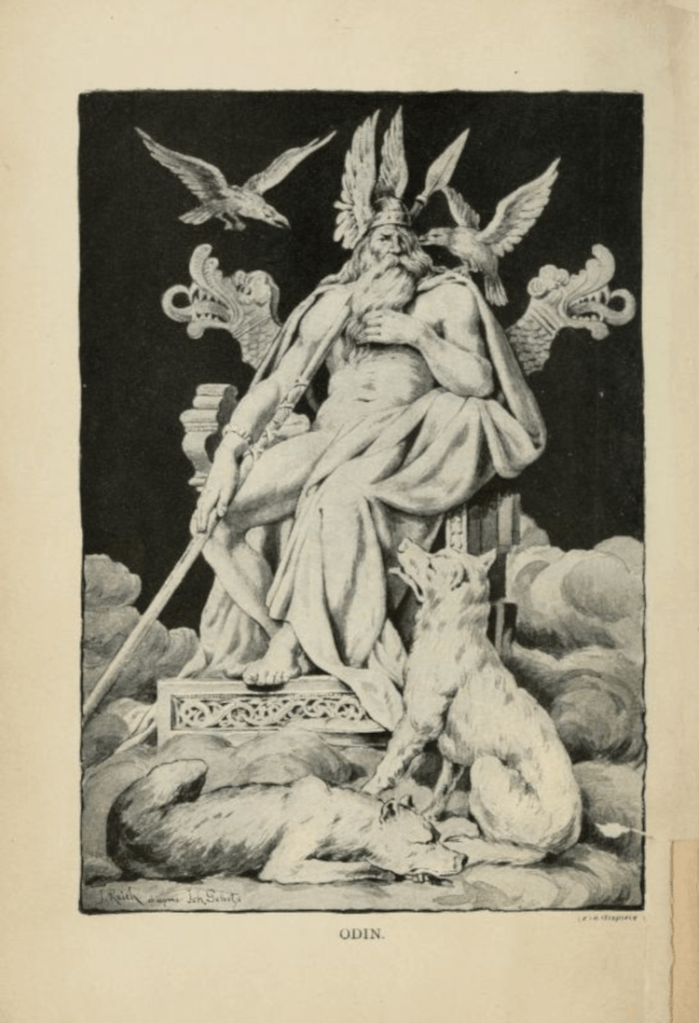
Under all manner of constraints and inspiration in the early days of the hobby, TSR, Judges Guild, et. al. commonly made use of old prints and other artwork in their published material. The illustration of Odin pictured above closes out Dungeons & Dragons Supplement IV: Gods, Demi-Gods & Heroes (1976).
As with much of the old art which appears in the hobby’s early pages, it is included without formal attribution. We are fortunate enough that the artist’s signature is just legible in the bottom left of the frame as J. Reich après Joh. Gehrts, that is “Jacques Reich after Johannes Gehrts.”
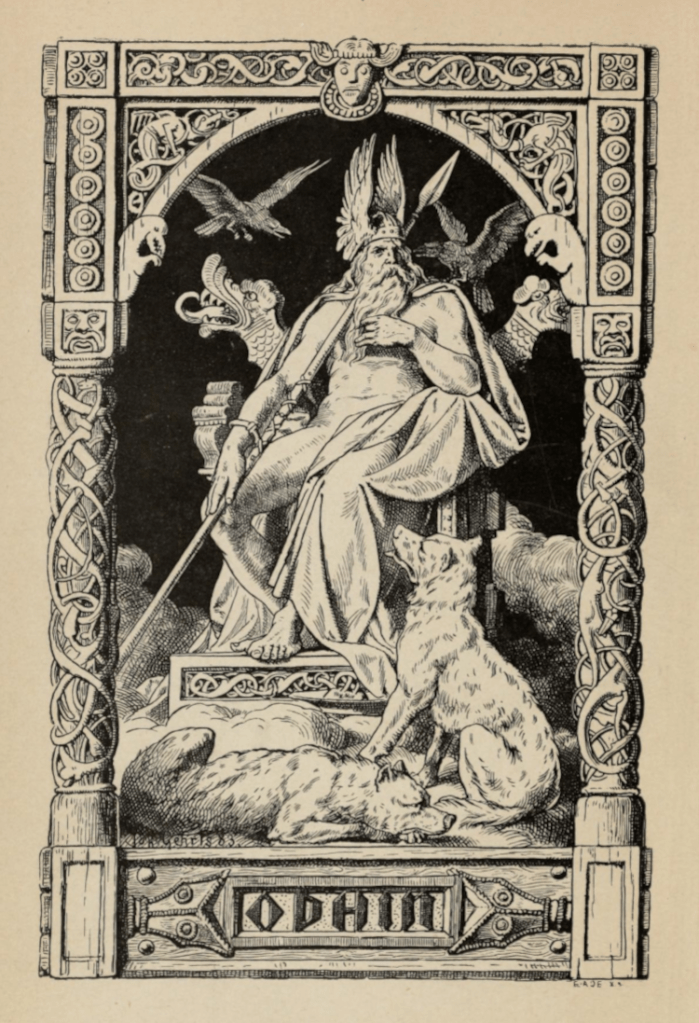
from Walhall: Germanische Götter-und Heldensagen [iii]
The printed engraving shown above is that of Johannes Gehrts’ 1883 original, used as the frontispiece of Felix Dahn’s Wahall (1888).
Jacques Reich, following the original composition, reworked Gehrts’ print as an illustration for Hélène Adeline Guerber’s Myths of Northern Lands (1895). It too is here used as a frontispiece, this time with the familiar centered caption reading “ODIN,” and in the bottom right corner, under the framing, “Frontispiece” between parentheses. This is the version which eventually worked its way onto the final page of Supplement IV.
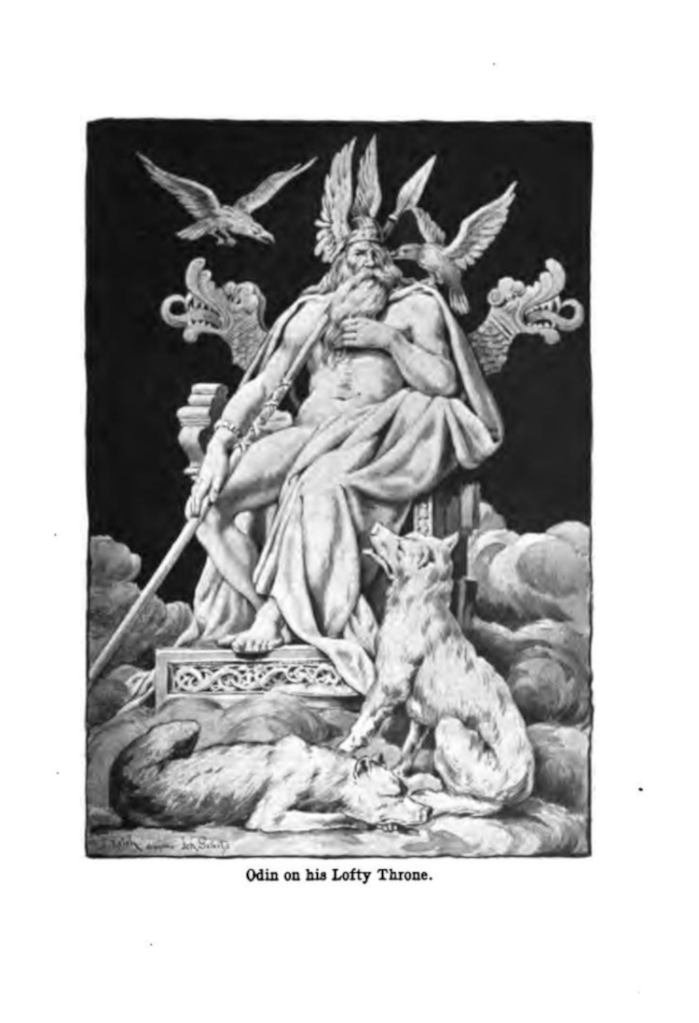
Many of the encyclopedias, compendiums, and collections which inspired or provided reference material in the early days lack formal attribution of their sources as well. Little more than a decade after Guerber published Myths of Northern Lands, Sarah Bradish included Reich’s illustration in Old Norse Stories (1900) with a new caption reading “Odin on his Lofty Throne.”
Perhaps the temporal fame of the original artist was taken for granted; or perhaps the artist’s signature in the illustration was deemed sufficient for a curious reader.[vi] However, the names of artists, their other work, and the sources are often lost along the way. The title page illustration of Supplement IV, for example, is one such piece deserving a post of its own as we recover inspiration from the wellspring of art and literature.
[i] Huysmans, J.-K. Against the Grain. Trans. John Howard. New York: Lieber & Lewis, 1922.
[ii] Ward, James, and Robert Kuntz. Dungeons & Dragons Supplement IV: Gods, Demi-Gods & Heroes. TSR Rules, 1976.
And we return from the stacks with a few painted leaves in hand.
“The Sign of Chaos flashed on their sails, eight amber arrows radiating from a central hub—signifying the boast of Chaos, that it contained all possibilities whereas Law was supposed, in time, to destroy possibility and result in eternal stagnation. The sign of Law was a single arrow pointing upwards, symbolising direction and control.” – Stormbringer, Michael Moorcock[i]
The signs of Chaos and Law are perhaps the most recognized among devices borne by protagonists within the Appendix N corpus.
“He looked down at the great, round shield with its shifting amber arrows and its mysterious silver-green colour. He picked it up easily enough and placed it on his arm. It virtually covered his body from chin to ankles.” Stormbringer, Michael Moorcock
The earliest extant depiction in print of the sign of Chaos appears in the Stormbringer graphic novel of 1976.[ii] TSR would soon illustrate the signs of Chaos and Law in the first printing of Deities and Demigods (1980).
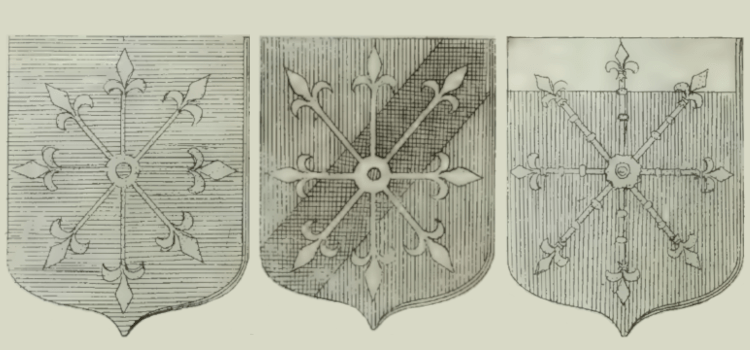
Moorcock describes the Sign of Chaos as ‘eight arrows radiating from a central hub,’ resembling more a heraldic escarbuncle charge than those illustrations in which the lines of the arrows simply intersect.
Examples of Escarbuncles, from Tesserae gentilitiae[iv]
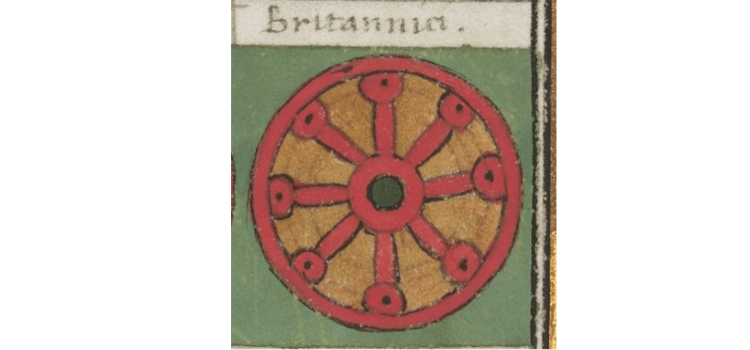
There is also passing resemblance to Legio Britannia Secunda’s shield device as given in the Notitia Dignitatum.
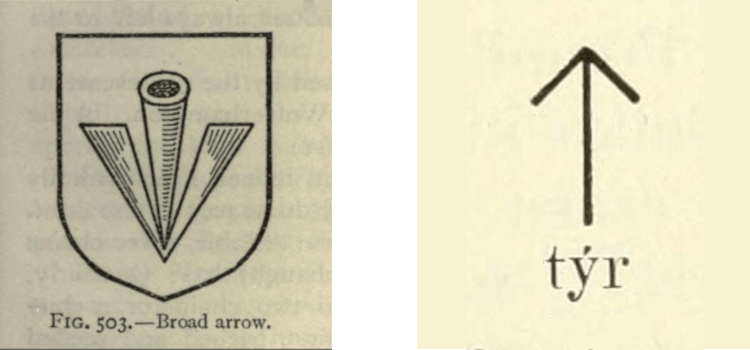
Arrows and spears are common enough charges in Western heraldic art, with the Pheon or Broad arrow variant most closely approximating the usual directional arrow representations of the Sign of Law.
Broad arrow from A Complete Guide to Heraldry, Fox-Davies,[vi] and Týr rune from Rycerstwo polskie wieków rednich, Piekosiski[vii]
Polish heraldic art makes frequent use of the basic form, as the strzała and rogacina charges, themselves stylized bar characters of arrow and arrowhead. Note also a resemblance between the Sign of Law and the Futhark t-rune, which letter derives from an ideograph for a spear.
Arrowhead variants from Heraldyka polska wieków średnich, Piekosiński[viii]
and Tablice odmian herbowych Chrząńskiego, Ostrowski[ix]
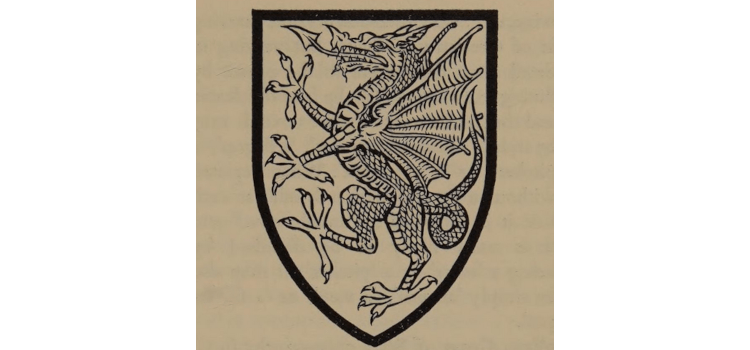
“Resting on the deck against the golden rail of the bridge was the great round warboard, his shield, bearing the sign of the swooping dragon.” – Elric of Melniboné, Michael Moorcock.
Elric, too, bore his own coat of arms, described as a swooping dragon.
A dragon segreant wings elevated, from An Encyclopaedic Dictionary of Heraldry, Franklyn[x]
“Turning, Hawkmoon recognized the insignia on the man’s coat as his own, the arms of Koln.”
And although he does not specifically describe it, Moorcock names Dorian Hawkwind’s coat of arms as those of Koln.
“Count Brass ordered his herald forward, and the men approached, bearing the simple flag of his master – a red gauntlet on a white field.” – The Jewel in the Skull, Michael Moorcock
The red slate roofs and scarlet flamingoes of the Kamarg, Count Brass’s bronze tan “glowing red,” this larger-than-life hero’s strength and protection, all find their thematic echo in his armorial bearings.
“Count Brass looked hard at the carriage. […] On the doors was an elaborate coat of arms displaying many quarterings in which were strange-looking animals, weapons, and symbols of an obscure but disturbing nature. Count Brass recognized the design of the carriage and the coat of arms. The first was the workmanship of the mad smiths of Granbretan; the second was the coat of arms of one of that nation’s most powerful and infamous nobles.” – The Jewel in the Skull, Michael Moorcock
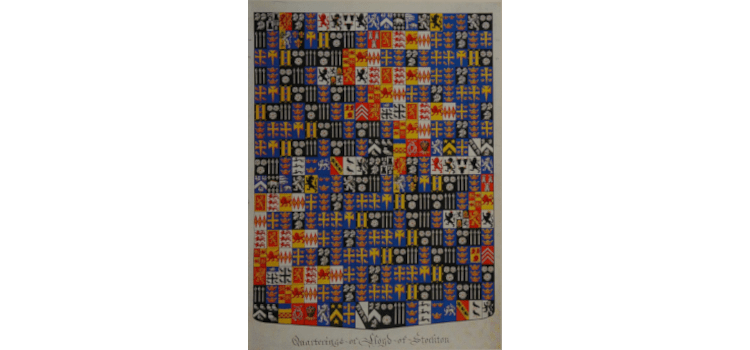
In stark contrast with Count Brass’s simple device, the elaborate, many-quartered coat of arms of Baron Meliadus readily illustrates the anxious, fanatic decadence of Granbretan.
The Quarterings of Lloyd of Stockton, an extreme example, from The Oxford Guide to Heraldry, Woodcock[xi]
“… memories going back to my childhood in the great palace of Amber, with the green banner of my father Oberon flaring above it, white unicorn rampant, facing to the dexter.” – Nine Princes in Amber, Roger Zelazny
Zelazny’s chronicles of Amber abound with color and symbolism. Corwin’s personal colors thread black and silver through his memories until he reclaims them walking the Pattern, finally recalling the Sign of the Unicorn, the arms of his father Oberon.
A unicorn rampant, from The Art of Heraldry, Fox-Davies[xii]
“When I was dry again, I was given fresh garments, of black and of silver. I donned them, and a black cloak was hung about my shoulders, its clasp a silver rose. ‘You are ready,’ said the sergeant of the guard. ‘Come this way.’” – Nine Princes in Amber, Roger Zelazny
We turn now a few idle leaves in the ancient histories of our hobby and peruse some of those marks of distinction called armorial bearings or coats of arms.
‘Yes, I seek a man.’ Carahue’s eyes were shrewd above the rim of his goblet. ‘Mayhap you’ve heard news of him? A big fellow, about your size, but yellow-haired. Most likely he’ll ride a black stallion and bear arms either of an eagle, sable on argent, or of three hearts sanguine and three lions passant or.’ – Three Hearts and Three Lions, Poul Anderson[i]
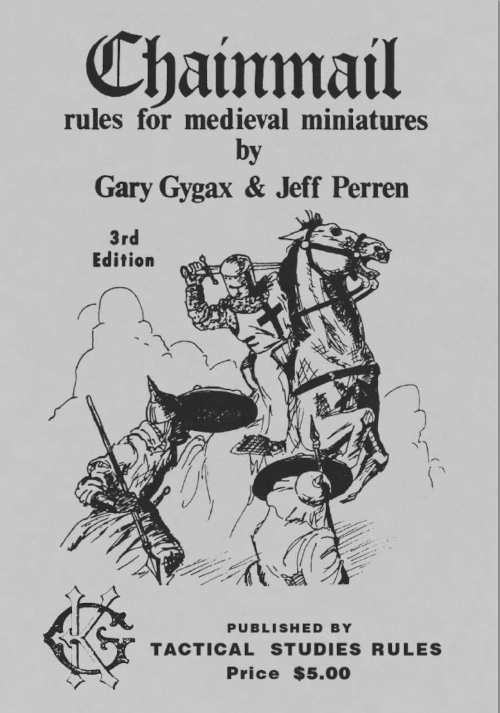
Although it has lately fallen out of fashion, the heraldic art has long graced the pages of tabletop roleplaying and its immediate wargaming predecessors. From 1970 through 1971, the Castle & Crusade Society’s newsletter, The Domesday Book,[ii] included such material in no less than four issues, in April, June, July 1970 and April 1971. Gygax and Perren also included examples of heraldic art as illustration in Chainmail. Later, in 1980 and 1983, the World of Greyhawk enriched its setting material with many more examples. Heraldry likewise embellishes the pages of the Appendix N and the sources upon which those writers drew.
from Chainmail, 2nd edition
Although not depicted with any tincture to aid in identification, the coats of arms in Chainmail[iii] present well-recognized charges. For the eagle displayed, the obverse of the great seal of the United States on the reverse of any dollar bill is a familiar sight, among other specimens.
from the Great Seal of the United States of America; Fox-Davies’ Complete Guide[iv]
For the three lions passant guardant, three fleurs-de-lys two and one, and the three ancient crowns two and one, the royal arms of England, France, Denmark, and Sweden together present suitable models.
Erik of Pomerania, Canute IV, from Nordic Antiquities and History[v]
The Black Prince, Edmund Langley, from Eve’s Heraldry as Art[vi]
English Royal Arms, from Friar’s Basic Heraldry[vii]
The shield was of conventional heraldic form, about four feet long, and obviously new. When he took the canvas cover off its surface, which was a thin steel overlay on a wooden base, he saw a design of three golden lions alternating with three red hearts on a blue background. A dim remembrance stirred in him. He stood puzzling for a while. Was this… wait. The Danish coat of arms. No, that had nine hearts. The memory sank down again. – Three Hearts and Three Lions, Poul Anderson
cover of 1961 printing
Within the Appendix N exist numerous examples of the heraldic art. The most prominent of which is Poul Anderson’s Three Hearts and Three Lions, with the description of Holger’s coat of arms furnishing the title. As in the primary sources on which Anderson draws, the use of armorial bearings identifying a character—and either their identity or mistaken identity—often features in the narrative.
Afterward he [Carahue] and Holger checked what equipment they had. His armor was a steel corselet, flaring at the shoulders and elaborately arabesqued; a spiked helmet with chainmail earflaps; greaves atop boots of tooled leather. His shield bore a six-pointed star argent on a field azure, border gules fleury or; his weapons included a bow and arrows; he rode a slim white mare. – Three Hearts and Three Lions, Poul Anderson
While primary sources do not describe Ogier the Dane’s armorial bearings, Anderson models Holger’s on the Danish coat of arms.[viii]
illustration, Holger Danske
Of the many secondary sources narrating the life of Ogier the Dane, those of Bulfinch, Lang, and Hans Christian Andersen have perhaps been the most popular among English readers. Poul Anderson’s most direct model for Holger’s arms appears to be in Han Christian Andersen’s fairy tale of Holger Danske.
And the old grandfather nodded again; and the more he looked at his Holger Danske, the more obvious it was to him that he had carved a good figure,—nay, it even seemed to him as if it assumed the colour of life, and as if the armour glittered like iron and steel: the nine hearts in the Danish arms seemed redder and redder, while the lions, with their gold crowns on their heads, were actually leaping.
‘They are certainly the finest arms in the world,’ said the old man. ‘The lions stand for strength, and the hearts for mercy and love.’ And he gazed at the uppermost lion, and thought of King Knut, who chained illustrious England to the Danish throne; and he looked at the second lion, and thought of Waldemar, who united Denmark, and conquered the Vandal states. Then he looked at the third lion, and thought of Margaret, who was the bond of union between Denmark, Sweden, and Norway. But while he was gazing at the red hearts, they glowed yet more brightly than before, and became flames that moved, and his mind followed each of them in turn. – The Fairy Tales of Hans Christian Andersen[ix]
Indeed, Andersen’s grandfather specifically describes the attributes of three lions and of three hearts only, somewhat different than the incompletely carved, quartered arms shown in his text’s illustration.
“Right now he had to keep alive in a land where a good many beings had it in for one who bore three hearts and three lions.” – Three Hearts and Three Lions, Poul Anderson
Our adventures will soon continue into the world of Greyhawk and even deeper into the Appendix N Plus wilderness!
[viii] Holger is the protagonist of Anderson’s Three Hearts and Three Lions. Through primary and secondary sources he is called variously Holger Danske, Ogier the Dane, Oddgeir Danski, etc.
It is high time that we turn a page or four in the Appendix N, with Tolkien, Anderson, Dunsany, and Moorcock, the Appendix’s last extant, living author.
“Naturally, the origin of each sword is either Law, Neutrality, or Chaos, but some of these weapons are forged by more powerful forces for an express purpose.”
In our contemporary age, in which magic items proliferate in fantasy realms like so many mass-produced mundanities, such a statement, presented in D&D, vol. II, Monsters & Treasure, should sound strange and foreign. And well it should. The statement depends upon a milieu in which a sword’s uniqueness, or at least its purpose, and its alignment are integral factors. And although it is tempting to go into a deeper exploration of Moorcock and Anderson’s influence on alignment in roleplaying gaming, we’ll save that for another day, and this adventure we will pursue instead the legend of the magic sword in the Appendix N.
from Handbook of the old-northern runic monuments of Scandinavia and England
“Magical Swords: Because these weapons are almost entities in themselves, they accrue real advantage to the figure so armed. In normal combat they merely add an extra die. It is in fantastic combat the Magical Swords are most potent.”
Chainmail 2nd edition
The magic sword is present already in Gygax’s earliest tabletop fantasy material. Magical swords and enchanted arrows comprise the two specific kinds of magical weapons detailed in the Chainmail fantasy rules.[i] Described as “almost entities,” magical swords shed light and dispel darkness. Arneson would later claim that the “nature and powers” of his own swords came from the pages of Chainmail.
“Prior to setting up Blackmoor, I spent a considerable effort in setting up an entire family of Magical Swords. The Swords, indeed comprise most of the early magical artifacts. … The Magic Swords of Mythology are varied creatures that can give great powers to their owners, who sometimes are helpless without them. Only Swords have these powerful variations and capabilities. Other weapons being relegated to lesser bonuses due to their shapes, that do not lend themselves to magical incantations.”
The First Fantasy Campaign
Thus, in the Blackmoor campaign, the magic sword also figured as the prominent magical weapon. Arneson described his family of magic swords and their special properties in The First Fantasy Campaign,[ii] and D.H. Boggs has conducted some research into the origins of the special characteristics which Arneson attributed to his swords.[iii] Interestingly, and expanding from Chainmail, a sword bearer’s alignment was a factor for Arneson, as Greg Svenson attested, “Dave’s perception of our alignment, as it is called now, affected whether we were able to hold the magic sword we found during that first adventure.”[iv]
“SWORDS: Among magic weaponry swords alone possess certain human (and superhuman) attributes; Swords have an alignment (Lawful, Neutral, or Chaotic), an Intelligence factor, and an egoism rating (as well as an optional determination of their origin/purpose).”
D&D, vol. II, Monsters & Treasure
In 1974, Dungeons & Dragons formalized the myth of the magic sword, assigning not just alignment, but also individual personality and attribute scores to its magic swords exclusively.[v] Other miscellaneous, magic weapons gave a bonus to hit and damage (with some exceptions) and included mace, axe, bow, arrows, daggers, spears, and hammers. These miscellaneous magic weapons however did not demonstrate any personality, and with the exception of a hammer and couple of daggers, neither did they exhibit any special powers or abilities.
“Most players will be unwilling to play swords with personalities as the personalities dictate.”
Players could find their characters at odds with their sentient swords at inopportune times, even when their alignments were otherwise compatible. Sentient swords, being intelligent and willful, might very well lead their bearers past better weapons or require a share of treasure. At other times, the influence of a sentient sword might prove more nefarious than simple jealousy or greed if its origin and purpose so dictated. And by the advent of AD&D, not every sword would necessarily exhibit sentience. Yet, except for certain artifacts, sentience was still the strict domain of swords, those few and unusual creations imbued with primary abilities, extraordinary powers, or a purpose.
“Swords: An Ego sword is a blade literally possessed by a type of Demonic force. The personality of the sword (IQ, Wisdom, Alignment) is determined as for a person. It will invariably seek glory in battle, and if its combined IQ and Wisdom are ever higher than its owner’s, it will lead him into danger to test his worthiness to own such a fine weapon and to gain the opportunity of slaying enemies. Ego swords are intensely jealous of any other swords the owner may possess, especially magical swords.”
Chivalry & Sorcery
The concept of the sentient sword was also present in other early roleplaying games, such as 1977’s Chivalry & Sorcery, where they existed side-by-side other types of enchanted arms and armor created by Artificers.[vii]
“Most swords (and all daggers) of magical nature shed light when drawn from their scabbard.”
AD&D, Dungeon Masters Guide
With few exceptions, in Chainmail fantasy rules, D&D, and AD&D, magic weapons were all depicted as shedding light when drawn. There is certainly precedence for such in fantasy literature, as in Tolkien, with those blades forged in Gondolin shedding light under certain circumstances, as might other magic weapons.
“Desperate, [Frodo] drew his own sword, and it seemed to him that it flickered red, as if it was a firebrand. Two of the figures halted. The third was taller than the others: his hair was long and gleaming and on his helm was a crown. In one hand he held a long sword, and in the other a knife; both the knife and the hand that held it glowed with a pale light.”
The Fellowship of the Ring, Book 1, Chapter 11, A Knife in the Dark[viii]
“[Frodo] drew out Sting: it flashed and glittered like a blue flame and then slowly faded again and grew dull.”
The Fellowship of the Ring, Book 2, Chapter 6, Lothlórien
And so, too, would Moorcock’s Stormbringer shed light under certain circumstances, though of a different aspect.
“Almost at its own volition the huge runesword sprang from its scabbard and black light poured from its blade as it began to hum its own strange battle-cry.”
Stormbringer’s power of stealing souls has been rendered in rules beginning with D&D’s “Life Energy Draining” ability, and later revised in AD&D as “Life Stealing,” although the runesword’s powers and character have appeared more explicitly elsewhere in fantasy gaming.
“Blackrazor is a negative-energy entity that exists by absorbing positive life energy levels from those it kills. […] Blackrazor exists solely to feel power and souls coursing through itself, and sometimes it may not be too picky about where the energy is coming from.”
“‘Wormbrand Soulstriker’, who is actually a type IV demon in eternal service to the lord. Wormbrand’s sole purpose in ‘life’ is to provide the demon with life energy by stealing the souls from humans.”
The Book of Treasure Maps, Scenario Four: Willchildar’s Well[xi]
“SOUL CLEAVER: This sword is always CHAOTIC. The sword will eat the souls of those it hits in combat. Unless the victim makes his saving throw he is a soulless dead hulk.”
There is more than passing similarity between Anderson’s description of Tyrfing in The Broken Sword and Moorcock’s description of Stormbringer.[xv]
“Still Stormbringer sang its sinister battle-song and still the runesword passed its power to its master so that with every death Elric found strength to slay more of the soldiers.”
“Yet this is the curse on it: that every time it is drawn it must drink blood, and in the end, somehow, it will be the bane of him who wields it.”
The Broken Sword
“…and the runes in Alveric’s far-travelled sword exulted, and roared at the elf-knight…” […] “And no more shock came to him from any of those swords, but only a vibration in his own sword’s metal that passed through it like a song, and a kind of a glow that arose in it, reaching to Alveric’s heart and cheering it.”
“And the savage, lusting sword that had thirsted for a hundred years went up with the hand of Rold and swept through a tribesman’s ribs…. And there arose the sounds of the exulting of victorious men, and the panting of those that fled, and the sword singing softly to itself as it whirled dripping through the air.”
Such similarity runs through Dunsany, Anderson, and Moorcock’s description of their fated swords, familiar phrases and images often echoed or repeated like a refrain.
“Earth clung damp to the halves of the broad blade. It had been two-edged, and so huge and heavy that only the strongest of men could readily wield it. […] Runes that Skafloc could not read went down the dark blade. He had the feeling that the mightiest of these were hidden on the tang.”
The Broken Sword
“Can you not sense it? The power and hunger locked in that steel, held by those unknown runes. The sword may be from the gods, but it is not of them. There is a curse on it, Skafloc. It will bring the bane of all within its reach.”
The Broken Sword
Compare, too, these scenes from the Saga of Hervör and Heithrek and Anderson:
“She could now see the fires of the barrows and the ghosts standing outside; and she approached the barrows fearlessly and passed through the fires as if they had been merely smoke, until she reached the barrow of the berserks. Then she cried: Awaken, Angantyr, hearken to me! The only daughter of Tofa and thee Is here and bids thee awake! Give me from out the barrow’s shade The keen-edged sword which the dwarfs once made For Svafrlami’s sake.”
Stories and Ballads of the Far Past, Saga of Hervör and Heithrek[xix]
“The fire roared taller. The wind shrieked like a lynx and clouds swallowed the moon. Skafloc cried out: Waken, chieftains, fallen warriors! Skafloc calls you, sings you wakeful. I conjure you, come on hell-road. Rune-bound dead men, rise and answer! The barrow groaned. Higher and ever higher raged the icy flame above it.”
The Broken Sword
Tolkien as well provided his protagonists with magic blades from a barrow early in their career.
“For each of the hobbits he chose a dagger, long, leaf-shaped, and keen, of marvellous workmanship, damasked with serpent-forms in red and gold. They gleamed as he drew them from their black sheaths, wrought of some strange metal, light and strong, and set with many fiery stones. Whether by some virtue in these sheaths or because of the spell that lay on the mound, the blades seemed untouched by time, unrusted, sharp, glittering in the sun.”
The Fellowship of the Ring, Book 1, Chapter 8, Fog on the Barrow-Downs
While Tolkien, Anderson, and Dunsany had already left their marks on literature before Moorcock, Gygax, and Arneson, their common sources were in an older tradition of literature.
“Called Angervadil, or grief-wader, sometimes, too, brother of lightning. […] Faint were the runes when the land was in quiet throughout all its borders; But when the followers of Hild were summoned, then were they burning Red as the comb of a cock when he fighteth. Lost was the warrior Who met, on the field of encounter, the blade with its red letters glowing.”
“Tyrfing had this characteristic, that whenever it was unsheathed it shone like a sunbeam, even in the dark, and could only be sheathed with human blood still warm upon it. Never did he whose blood was shed by Tyrfing live to see another day. It is very famous in all stories of the olden days.”
Stories and Ballads of the Far Past, Saga of Hervör and Heithrek
Magic arms and armor lie strewn through myth and legend—these companions of heroes of old, dusty artifacts of another, timeless age. Stormbringer may have guided the form of sentience, ego, will, alignment, and purpose magical swords assumed at the origin of gaming; and players may have shied away from such unpredictable companions given the choice. But ever longing, have fated rune-blades as Angervadil and Tyrfing thirsted to shake off the dust and shed light and blood once more.
“Smite your foemen – gods, giants, mortals, it matters not. The sword is loose and the end of the world comes nigh!”
Let us then continue the course of our wilderness adventures.
Among the lists and tables in the AD&D 1st edition appendices, Gary Gygax presents the Appendix J: Herbs, Spices and Medicinal Vegetables as a guide to substances which a Dungeon Master might assign in the creation of permanent or consumable magic items.[i] The absence of game mechanics per se and Gygax’s closing statement regarding “folk uses” of herbs supports the Appendix J’s intended purpose.
He does nevertheless leave such usage up to the DM’s discretion, and, as his prefatory advises, “the dedicated herbologist will have to pursue his or her research in scholarly texts.” The question then remains: which scholarly texts did Gary Gygax make use of when drafting Appendix J?
AD&D 1st edition, Dungeon Masters Guide
The Appendix J lists one-hundred seventy-one distinct substances in alphabetical order, often including alternate names in parentheses, each item with an accompanying comment on its uses or powers. At a first glance, the list suggests Nicholas Culpeper’s Complete Herbal as a possible reference text; and indeed, forty-seven of the items on the appendix list appear in Culpeper’s 17th century work.[ii] A reasonable starting place, as Culpeper’s work had since greatly influenced herbals published in English.
Maud Grieve’s 1931 A Modern Herbal instead provides us with one-hundred seventy of the appendix items, duly citing Culpeper as appropriate; and its entries generally exhibit a similar style of language on “medicinal uses” to the properties that Gygax condensed into his comments.[iii] The single odd-ball substance Gygax lists is muira-puama, of which we will speculate in the conclusion.[iv] Let us instead focus on a further analysis of the appendix text.
Rather than commenting on a substance’s uses or powers for ten items (bay leaf, cardamom, chervil, garden burnet, lotus, peppermint, poppy, spearmint, tarragon, and turmeric), Gygax simply gives a question mark.
Many of these entries in Grieve’s herbal tend to vary from a standard or easily condensable description. The mints are all listed together, for example, as are varieties of cardamom. Lotus in Grieve is entered as White Pond Lily—though a subtextual relation to Robert E. Howards work is tempting to identify. In Grieve, the Red Poppy shows no special properties, whereas the White Poppy, of course, is a narcotic. And tarragon’s medicinal use in Grieve might perhaps best be condensed as a “cure for toothache” and “liver.”
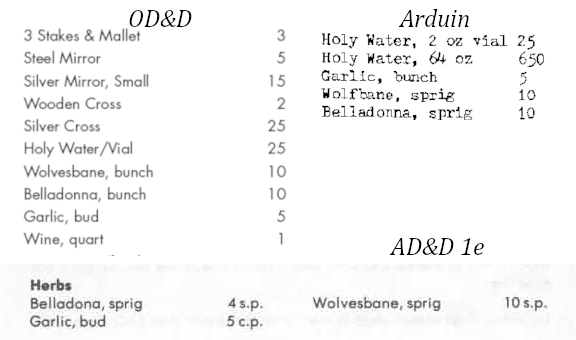
Equipment Tables from OD&D, AD&D 1e, and Arduin
While it’s challenging to ascertain why Gygax may have left those ten items without comment, he did provide specific narrative functions to the traditional “holy trinity” of OD&D[v] and AD&D[vi] “basic equipment” herbs (wolfsbane, belladonna, and garlic); and a curious addition of chives (evil eye) and rosemary (drives off evil spirits). Grieve cites rosemary’s use as “a safeguard from witches and evil influences.” As for chives, its appendix comment may very well have come from the plant’s popular association of onions and garlic with such matters as warding off the evil eye, and neither Grieve nor Culpeper have anything to say of that matter.
AD&D 1st edition, Dungeon Masters Guide
This brings us back to muira-puama, a rather unique entry on the appendix list. Considering Gygax’s wide reading, or perhaps his anthropological studies, the source may very well have been from an ethnological journal as from a passing mention in Playboy magazine. Muira-puama is one of two items in the appendix that list “aphrodisiac” as a power—juniper is the other item, and neither Culpepper nor Grieve attribute to juniper any aphrodisiacal qualities (rather, they mention juniper as a type of emmenagogue). This may provide a clue for future investigation, but as of now, Gygax’s source or reason for including muira-puama remains a mystery.
Many years later Gary Gygax would write his World Builder and include in it a list of flora, incorporating much of the Appendix J items—leaving out muira-puama—, many additional organic substances, and accompanying reputed symbolic meanings.[vii]
Bunnies & Burrows in 1976 provided an herb list with game effects,[viii] and 1977’s Chivalry & Sorcery presented an extensive list of organic compounds for purchase from an apothecary (including, of course, Black Lotus).[ix]The Arduin Grimoire provided the usual “holy trinity” of garlic, belladonna, and wolvesbane in 1977,[x] even retaining the same numerical list price as OD&D (later corrected to a silver price rather than gold in Arduin, vol 2),[xi] although using a variant spelling of wolvesbane as wolfbane. And later, in 1982, Rolemaster would present players with a comprehensive list of magical, fantasy herbs for use.[xii]
Indeed, although a list of herbs for use in roleplaying games is by no means exceptional, it yet remains an uncommon thing for game designers to include. Even the “holy trinity” of equipment list herbs has fallen off of D20-era Pathfinder’s and D&D’s adventuring gear. Perhaps someday, such lore and narrative potential once again revives in roleplaying literature. In the meantime, as far as this research concludes, Gygax’s immediate primary source for the Appendix J list appears be Maud Grieve’s A Modern Herbal, and well may her work provide future campaigns with a wealth of material.
We will begin our adventures with a brief foray into the Plus of the Appendix N wilderness.
The Gygax-Kaye monogram graced the covers of TSR’s efforts from its first publication in 1973 of Cavaliers and Roundheads until being replaced with Greg Bell’s Lizardman image in 1975. It was the company’s first logo, representing the partnership of Gary Gygax and Don Kaye, and it would herald them through TSR’s first formative years.
Chainmail, 3rd edition
The source material of much of the early artwork at TSR[i] and its precursors has been discussed over the years.[ii] From Jack Coggin’s knight[iii] appearing in the Castle & Crusade Society’s Domesday Book #5 and on the cover of Chainmail to Greg Bell’s Dungeons & Dragons illustrations inspired by panels of Dr. Strange.[iv] However, one question remained outstanding.
As Art & Arcana relates, Gygax was not a draftsman, and he eagerly canvased his social circle for contributions in those early years without an art budget.[v] Yet the hand that drew the “bold” and “distinctive” monogram does not resemble that of any of the early contributors. What, then, was the origin of the Gygax-Kaye monogram logo?
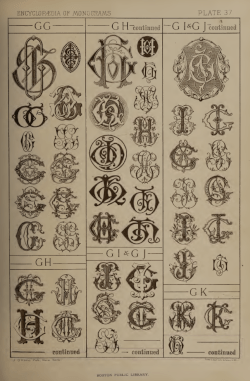
James O’Kane’s An Encyclopædia of Monograms
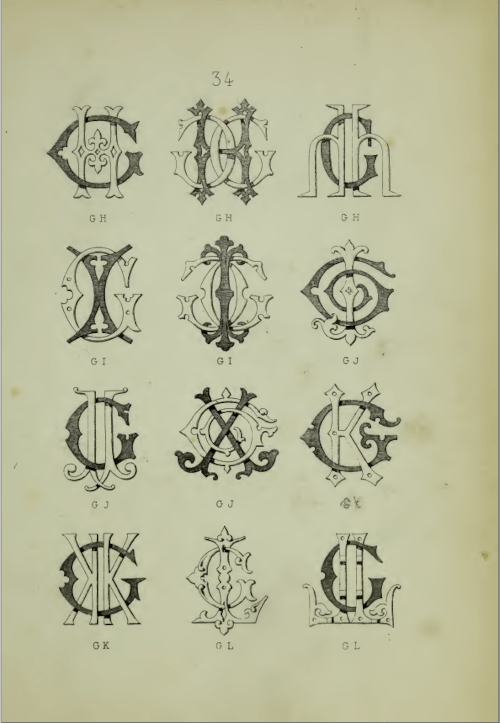
Preliminary research in the Lake Geneva Public Library’s catalogue returned no promising leads. Instead, an effort manually searching texts at the Internet Archive showed some result. James O’Kane’s An Encyclopædia of Monograms, published in 1884, exhibited multiple close, but not exact G.K. monograms (Plates 37, 38, and 55).[vi] Perhaps as a model for inspiration, it was close; but these entries in the Encyclopædia also suggested a period and style to refine the research. And indeed, further searching returned an anonymous record, simply titled, A monogram and alphabet album. Plate 34 contained the exact G.K. monogram logo.[vii]
A monogram and alphabet album
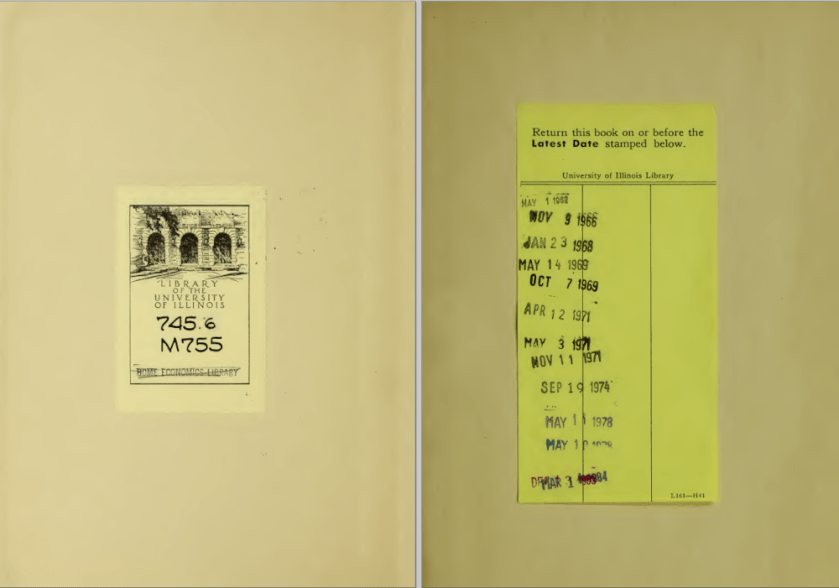
The Internet Archive record was sparse, noting no title page or author, but indicated an 1878 publication date and English as the text’s language. More interestingly was the contributor, the University of Illinois Urbana-Champaign, and the book’s call number, 745.6 M755. Searching the University’s catalogue returned an entry for the book, its location in the Oak Street Library vaults,[viii] and link to a scanned copy hosted at the Hathi Trust digital library.[ix] These additional library records all indicated the book’s language as English, although the few lines of text in the book were clearly written in French.
from Cirker’s Monograms and Alphabetic Devices
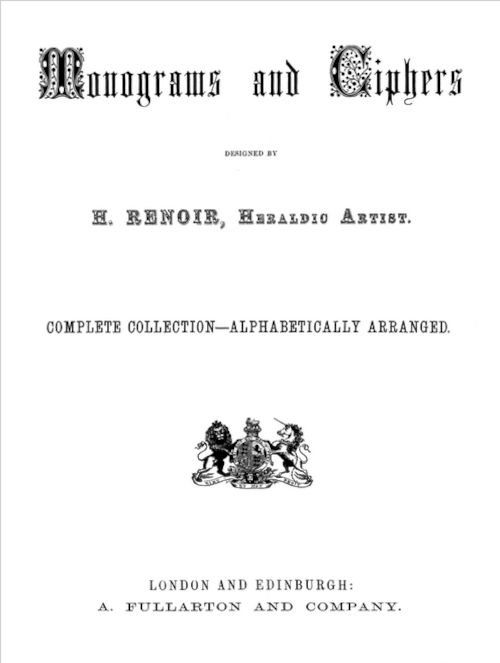
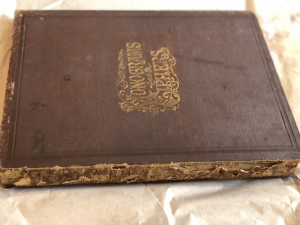
Pursuing the French connection quickly returned a modern, 1970 reprint of the plates in Cirker’s Monograms and Alphabetic Devices, [x] with a copy being held by the University of Illinois;[xi] and it also revealed the name of the monogram’s original French draftsman: H. Renoir. WorldCat[xii] provided further identity confirmation and various titles, including the original French title Chiffres et monogrammes, and print dates in France (Sarazin, Paris) in Germany, and the English title Monograms and Ciphers, published at Edinburgh.[xiii] The task remaining was to recover an intact copy at auction and examine the English edition’s cover and title page.[xiv] The physical book’s cover and binding were in a state of disintegration, and if the edition is a proximate example of the one held at the University of Illinois, the missing cover and title page are readily explained. Several questions, however, remain.
Monograms and Ciphers
While it is tempting to name the mysteriously labeled A monogram and alphabet album held by the University as the unique source from which someone copied the Gygax-Kaye monogram, Dover had also just recently published Cirker’s Monograms and alphabetic devices in 1970, and that may very well have been the reference text. Nevertheless, the missing title page and the penciled-in “GK” in the “album,” the only such marked monogram in the University’s copy, remain suggestive, together with the April, May, and November 1971 dates stamped on the album’s flyleaf.
A monogram and alphabet album, flyleaf
Still, the evidence so far examined is perhaps at best circumstantial, even considering the tantalizing note in Peterson’s Playing at the World that “By 1970,” Gary’s confidant Len Lakofka was “pursuing a master’s degree at the University of Illinois at Urbana-Champaign.”[xv] It’s tempting to imagine Lakofka and Gygax huddled together over an old, crumbling book’s pages. Yet, without further investigation in physical catalogues, if they are even extent, it is uncertain where either volume was located in the early 1970s.
Which text was Gygax’s source, and who, if anyone, supplied it to him and Don Kaye? The answer to that may perhaps be forever shrouded in the primeval mists of Lake Geneva. But as far as this research can now conclude, the ultimate source of the Gygax-Kaye monogram was one H. Renoir, author, illustrator, and heraldic engraver.
In 1978, The Dragon’s editor, while defending his decision to include fiction in his magazine’s pages, contended that roleplaying gaming “required large amounts of stimulation to ensure fresh and viable campaigns.”[1] As the hobby matured, and perhaps became increasingly self-referential to some degree, players and designers continued to draw upon their common literary and cultural heritage for inspiration and vigor.
This author contends that delving into the literary and cultural sources of roleplaying games not only provides a useful, and at least entertaining, dimension to our hobby, but that these sources are limitless fountains, offering a wealth of inspiration and wonder worth the seeking.
None of this culture exists in some vacuum or as a static thing in some museum, provided there is still some player with it in mind on some stage or at a table or desk, somewhere. Just as the creative process involves more than novelty seeking, and isn’t as original as some would have you believe; just as Shakespeare worked from Chaucer, Gower, folk lore, and medieval and classical texts, so does any player or designer looking to keep their narratives “fresh and viable.” This Appendix N Plus will delve into the sources and beyond. No single post should be read as a final word, as if the story were complete and told and done. It is a work in progress, the evolving results of research, a journey, if you will.





















 Appendix N Plus


.jpg)
