
“The focus of interest in this study is more special: to trace man’s evolution as an artist and designer and to do this through the signs, seals and symbols he has left as his record.” – Ernst Lehner, “To the Reader,” Symbols, Signs & Signets
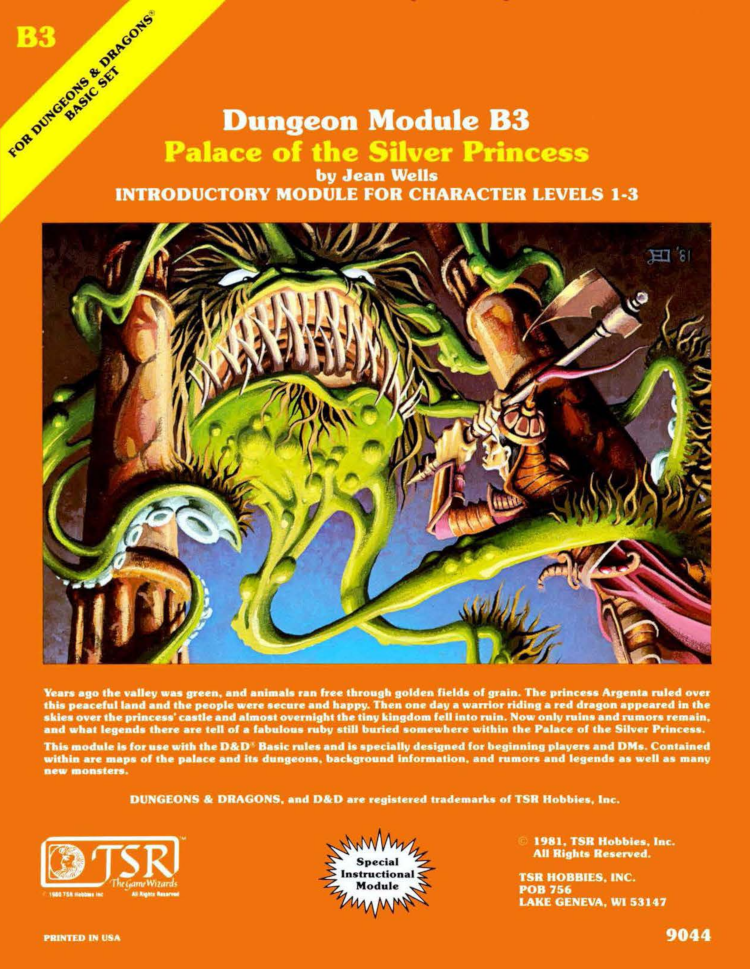

Covers of module B3 Palace of the Silver Princess [Orange] [i] and [Green] [ii]
In this article we will trace and identify the sources of some of the more obscure symbols used in illustrating the D&D module B3 – Palace of the Silver Princess. We will not venture to explain any occult significance of the symbols; and we presume there is no meaningful, occult intent behind choosing to include them in the module’s artwork. Neither will we be discussing the module’s history, which may be read over at the Acaeum.[iii] For our purposes, it’s enough to remark that the module underwent a complete revision from its original Orange-covered to its Green-covered form.
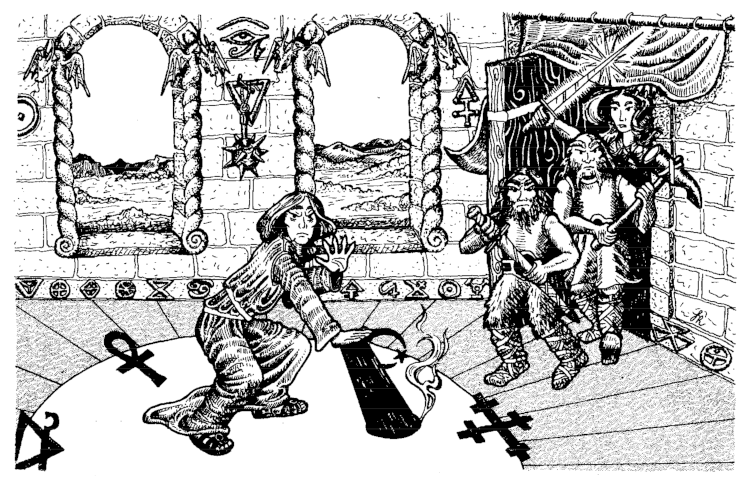
from B3 Palace of the Silver Princess [Orange]
At first glance, it is evident that a preponderance of the smaller symbols on the walls and floor of this illustration have been derived from Lehner’s Symbols, Signs & Signets.[iv]
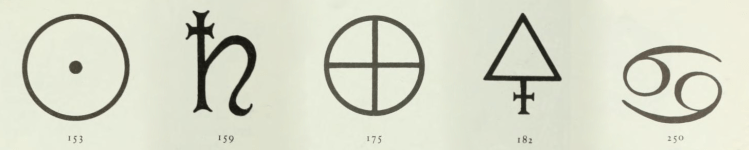
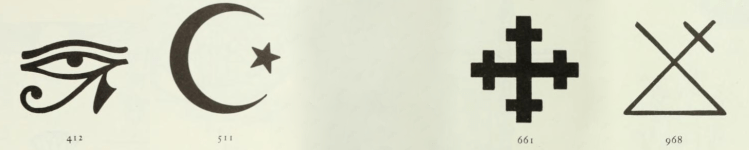
A selection of figures from Symbols, Signs & Signets
Collections of the kind were frequently mined for inspiration or material, literary or artistic; and Peterson has documented the influence of Lehner’s Fantastic Bestiary in Eldritch Wizardry (1976).[v] Here, the symbols are largely of a recognizable alchemical, astrological, and religious type.
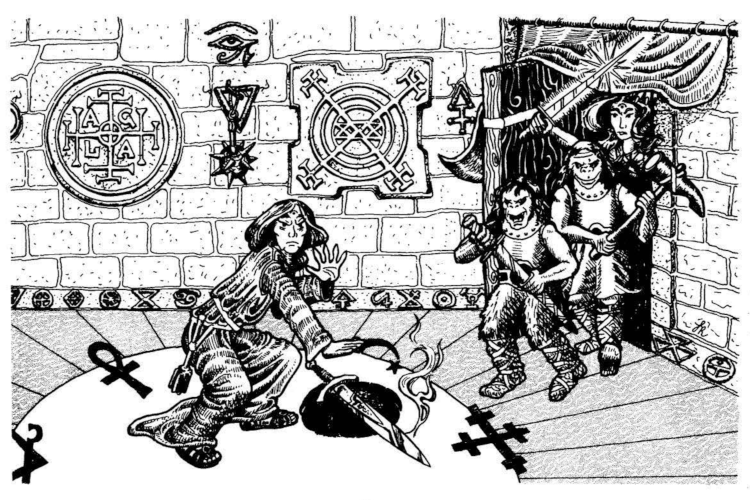
from B3 Palace of the Silver Princess [Green]
Of more interest is the change in illustration from Orange to Green versions of the module. In its original Orange-cover form, the chamber was an exterior-facing room of the palace with windows; and for the revised Green-cover form, converted into an interior room. The accompanying in-text descriptions are different. And, among other alterations to the artwork, the windows have been replaced with a couple of prominent symbols.

from Symbols, Signs & Signets, captioned BRINGS SUCCESS, WEALTH, LONG LIFE
Textual evidence indicates Lehner’s Symbols, Signs & Signets [vi] as the primary, immediate source here again, rather than his similar collection, The Picture Book of Symbols (1956)—namely, the absence of these two illustrations in the 1956 publication.[vii]
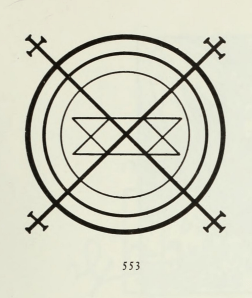
from Symbols, Signs & Signets, captioned THE HOLY MAGIC CIRCLE
Lehner’s bibliography is generally vague, more of a list of ‘works consulted,’ and the captions he has assigned to these two items, factitious at best. We can however trace their intermediate and ultimate sources.
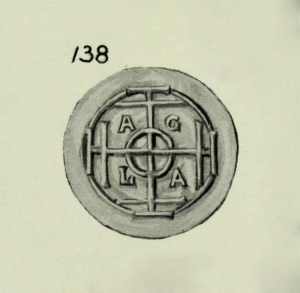
from The Book of Talismans, Amulets and Zodiacal Gems [viii]
Captioned as “Brings Success […]” by Lehner, he appears to have drawn it from William Pavitt’s Book of Talismans, Amulets and Zodiacal Gems, where Pavitt accurately identified the provenance of the figure with John Dee, though he in turn interpolated a significance of the AGLA acronym—i.e. use of the acronym as a medieval charm against Fever—alien to its usage by Dee.
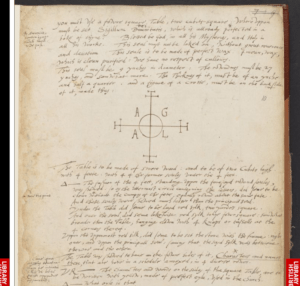
from Sloane Manuscript 3188f.10 [ix]
First recorded on March 10, 1582 in John Dee’s diaries, the ‘Seale with the figure of a Crosse […] made thus’ seems to be unique to Dee.
While there may be another intermediary source between Pavitt’s Book of Talismans and a printing of Dee’s notes, e.g. Mysteriorum Libri Quinque, Pavitt only appears to mention the AGLA acronym’s sometime use as a charm as an historical aside rather than as a specific description of Dee’s figure as illustrated.
In any case, the figure as eventually reproduced in Ernst Lehner’s collection ultimately originates with John Dee, who intended it to be used on the reverse of a large wax seal.[x]
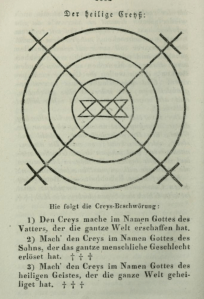
from Das Kloster [xi]
A twelve-volume collection of folklore, occult texts, and more, volume five of Johann Scheible’s Das Kloster contains a number of Faustian Höllenzwang.[xii] Ernest Lehner drew from this volume in particular, and his Symbols, Signs & Signets reproduces several figures from its pages.
The illustration above, drawn from the section entitled “Doctor Faustens dreyfacher Hoellenzwang,” is captioned as “Der heilige Creyß,” which Lehner would later rephrase as “The Holy Magic Circle.”
Scheible records the text as having been printed in Passau in 1407, somewhat before the historical Faust was born (c. 1480), and before the advent of Gutenberg’s printing press (c. 1436).

from Doctor Faustens Dreyfacher Hoellenzwang [xiii]
Narrowing our search, we find the earliest publication of this text—its use being still internally attributed to a Bishop Albrecht—in the collections at Heinrich-Heine-Universität Düsseldorf. Its catalog entry is titled Doctor Faustens Dreyfacher Hoellenzwang […].[xiv]
The archivist has identified a 1704 printing for the book, and the work’s typography supports an early 18th century printing. Some of the other, more complex illustrations within the text, later printed in Scheible, are here hand drawn.

John Dee, from Casaubon’s A True and Faithful Relation […] [xv]
And so, their provenance obscure, their meanings muddled over time as each successive author has reproduced or repurposed these illustrations, we have traced their descent from occult origins to D&D module B3 – Palace of the Silver Princess.
[i] Wells, Jean. Palace of the Silver Princess. TSR Hobbies, Inc., 1981.
[ii] Wells, Jean and Tom Moldvay. Palace of the Silver Princess. TSR Hobbies, Inc., 1981.
[iii] “B3 Palace of the Silver Princess.” The Acaeum.
[iv] Lehner, Ernst. Symbols, Signs & Signets. New York: Dover Publications, Inc., 1969.
[v] Peterson, Jon. “A Fantastic Bestiary.” Playing at the World, 2014, February 16.
[vi] Printed in 1950 by The World Publishing Company and republished in 1969 by Dover Publications.
[vii] Lehner, Ernst. The Picture Book of Symbols. New York: Wm. Penn Publishing Corp., 1956.
[viii] Pavitt, William Thomas. The Book of Talismans, Amulets and Zodiacal Gems. Philadelphia: D. McKay, 1915.
[ix] Dee, John. Sloane MS 3188f.10. British Library. Please note that of this writing, the British Library’s digital collections are still offline due to a cyber-attack. Black & White scans may be referenced HERE.
[x] Magical Disc, Museum number 1838, 1232.90.a, Asset number 964507001. The Trustees of the British Museum.
[xi] Scheibel, Johann. Das Kloster. Weltlich und geistlich. Meist aus der ältern deutschen Volks-, Wunder-, Curiositäten-, und vorzugsweise komischen Literatur, Volume 5. Stuttgart, 1847.
[xii] Höllenzwang, or Hoellenzwang, often translated as a “Coercion of Hell” or “Compulsion of Hell,” popular and usually anonymous texts, mostly originating during the 16th and 17th centuries.
[xiii] Anonymous. Doctor Faustens Dreyfacher Hoellenzwang […]. Passau, 1407 [attrib. 1704]; Electronic edition, Düsseldorf: Universitäts- und Landesbibliothek, 2016.
[xiv] Multiple, diverse texts have also borne this title.
[xv] Casaubon, Meric. A true & faithful relation of what passed for many yeers between Dr. John Dee and some spirits. London: D. Maxwell, 1659.

 Appendix N Plus